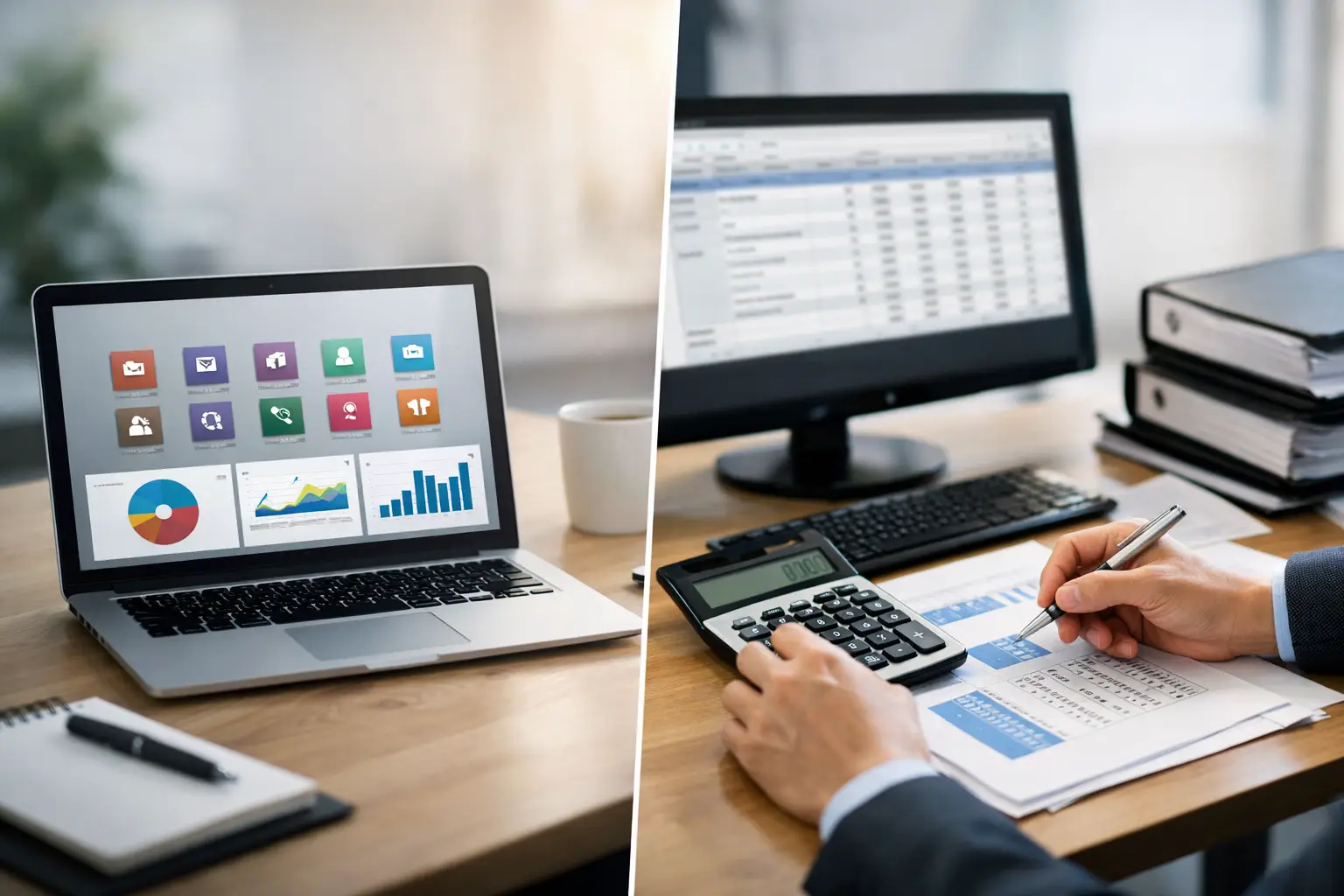
The true impact of a financial system decision is rarely felt when issuing the first invoice; it manifests when management attempts to determine the exact profitability of a specific branch, the cost of a delayed order, or the cause of an inventory valuation discrepancy. Framing the choice between Odoo and standalone accounting software is an operational decision that extends far beyond selecting a simple bookkeeping program. Your choice determines how data flows between sales, inventory, procurement, human resources, and project management—defining who reviews that data and how quickly it becomes actionable for decision-makers.
Standalone accounting software can function effectively when business operations remain simple and linear. However, enterprise growth introduces operational exceptions, complex approval hierarchies, additional branches, multiple sales channels, and third-party integrations. At that stage, the core challenge is no longer a bookkeeper's ability to record a journal entry, but the time and effort required to aggregate, verify, and reconcile source data before those entries can be posted.
What Is the Fundamental Difference Between Odoo and Standalone Accounting Software?
Standalone accounting software focuses primarily on core financial management: the general ledger, daily journal entries, accounts receivable, accounts payable, customer invoicing, financial reporting, and tax filings. It may connect to peripheral tools via manual data entry, CSV file exports, or basic API endpoints. Its primary purpose is managing the financial recording aspect of a business.
In contrast, Odoo is a fully integrated Enterprise Resource Planning (ERP) platform. Financial management in Odoo does not simply record transactions after they occur; it is directly embedded within daily operational workflows. A confirmed sales order seamlessly generates a customer invoice, stock deliveries update inventory valuations in real time, goods receipts record vendor liabilities, and project expenses or billable employee hours map directly to cost centers according to corporate policies.
This does not mean Odoo is automatically the superior choice for every organization. A fair evaluation depends on your operational complexity, the number of disparate tools your team relies on, and whether your leadership requires a single source of operational and financial truth. A small professional service firm with low invoice volumes may not require a full ERP suite initially. Conversely, an enterprise managing multiple warehouses, retail branches, field sales teams, projects, or Point of Sale (POS) terminals will quickly find that isolating accounting from daily operations creates an administrative burden that scales with every transaction.
Odoo vs. Standalone Accounting Software Under Operational Growth
When using standalone accounting software, the sales team operates on one platform, warehouse personnel track inventory in spreadsheets or dedicated tools, and the finance department manages entries in a separate accounting package. At the end of the day or week, data must be manually transferred across departments. While manageable at low volumes, this fragmented workflow frequently leads to mismatched due dates, duplicate invoice entries, item coding errors, and discrepancies between physical inventory and ledger accounts.
In Odoo, functional modules operate within a unified database and interconnected workflows. When a purchase order is approved, receiving, vendor bill generation, and payment processing follow predefined, role-based authorization paths. When a customer order is fulfilled, teams track its status seamlessly from quotation to delivery and cash collection. The value extends beyond reducing software interfaces; it eliminates manual data handoffs that are difficult to audit later.
Consider a distribution enterprise selling via field representatives, an e-commerce storefront, and a central warehouse. Standalone accounting software can report total sales revenue and receivables, but it cannot automatically reveal each sales channel's net margin, identify inventory reserved for pending orders, or track unbilled delivered shipments. Assembling these insights manually requires complex spreadsheets, administrative overhead, and constant cross-departmental coordination.
Conversely, a unified ERP system connects sales channels directly to inventory allocations, automated invoicing, customer payments, and returns. When third-party integrations—such as e-commerce platforms, shipping carriers, payment gateways, or POS hardware—are required, they become part of the automated operational workflow rather than delayed end-of-month reconciliation tasks.
When Is Standalone Accounting Software the Logical Choice?
Selecting standalone accounting software is not inherently wrong. It remains a practical choice for early-stage startups with limited user seats, low transaction volumes, and straightforward operations that lack complex inventory, multi-branch structures, or cross-departmental workflows. It can also suit organizations utilizing a highly specialized, industry-specific operational platform that only requires a simple financial ledger interface.
However, leadership must distinguish between low current requirements and postponing a growing operational bottleneck. If accountants spend significant time re-keying invoices, if management relies on manual spreadsheets to verify sales and inventory levels, or if month-end financial closing is delayed due to manual reconciliations, isolated accounting software is no longer cost-effective—even if its subscription fees appear lower.
Total cost of ownership involves more than software license fees. Organizations must factor in the cost of manual labor, data entry errors, delayed operational visibility, new employee onboarding friction, and the expense of building custom reporting tools from fragmented data sources. In many companies, these hidden costs are absorbed across departments, obscuring their impact while actively hindering operational agility.
Where Odoo Delivers Greater Operational Value
Odoo's primary advantage lies in making financial data a natural byproduct of daily operational execution rather than a separate administrative phase at the end of the month. Wholesale and retail businesses benefit from unifying procurement, stock management, sales, and POS terminals. Contracting and professional service firms gain complete visibility by linking customer contracts, project tasks, job costs, invoicing, and collections. Manufacturing and logistics companies achieve precise tracking of material movements, operational overhead, resource planning, and shop-floor execution.
Furthermore, role-based access controls and approval workflows strengthen internal governance. Organizations can define precisely who drafts purchase requisitions, who approves vendor bills, and who accesses executive financial reports—all backed by a clear audit trail. These controls are critical as teams expand across multiple locations, where relying on informal communication or undocumented approvals exposes the business to risk.
Local regulatory compliance must also be built into system selection. For businesses operating in Saudi Arabia, setup requirements include ZATCA e-invoicing compliance, VAT regulations, and compliant document management. An effective solution goes beyond placing an e-invoicing layer over old tools; it ensures that sales invoices, credit notes, debit notes, and master data flow in full alignment with real-world business practices.
Odoo Success Depends on Implementation, Not Software Licensing
An ERP platform can become an expensive hurdle if implemented merely as a digital replica of legacy manual processes. Prior to system deployment, an organization requires a thorough operational GAP analysis to map sales, procurement, inventory, and finance cycles, identify operational bottlenecks, define reporting needs, establish security roles, and plan necessary software integrations. This upfront work prevents unnecessary custom code and clarifies what processes to standardize versus what to keep flexible.
Practical execution decisions follow: cleaning customer master files, vendor directories, item master data, and charts of accounts prior to data migration; establishing a realistic go-live timeline; testing operational exception scenarios; and conducting role-based user training. Warehouse staff do not require full accounting training, but they must understand how receiving and shipping transactions impact inventory accuracy and ledger postings.
System integrations require careful architectural planning. Connecting Odoo to e-commerce platforms, shipping providers, biometric attendance devices, POS terminals, payment gateways, or specialized software must be built on clear data ownership principles. Implementation teams must define: Where is the customer record originally created? Which system serves as the single source of truth for stock balances? How does the architecture handle payment failures, canceled shipments, or customer returns? Resolving these questions upfront prevents critical post-launch operational disruptions.
How to Make the Right Choice for Your Organization
Evaluate your current operational environment against three practical metrics: how many times the same piece of data is manually entered across different tools, how long it takes to generate a reliable management report, and the number of end-of-month reconciliations required. High numbers across these metrics indicate that your challenge is an architectural data flow issue rather than a simple accounting problem.
Next, define your initial implementation scope. It is rarely necessary to deploy every Odoo application simultaneously. Most growing enterprises begin by unifying Accounting, Sales, Procurement, and Inventory, expanding into Project Management, Manufacturing, HR, or e-commerce channels in subsequent phases. A phased ERP implementation strategy minimizes operational risk—provided the core database architecture, data classifications, and security roles are designed for future expansion from day one.
Your implementation partner must translate executive vision into robust system configurations, testing protocols, user training, and ongoing technical support. Global Solutions delivers end-to-end Odoo implementation services—from GAP analysis and custom development to API integration, data migration, user training, and post-go-live support—helping organizations establish an ERP foundation that reflects their actual operating model.
Before committing to a platform, ask your team to trace a single, complete transaction cycle: from initial customer order to fulfillment, invoicing, journal posting, and financial reporting. A workflow that looks simple on paper quickly reveals where data redundancies occur and where decisions stall. Choosing the right platform starts with understanding this operational path and building a unified solution that gives finance and operations a single language for sustainable growth.