



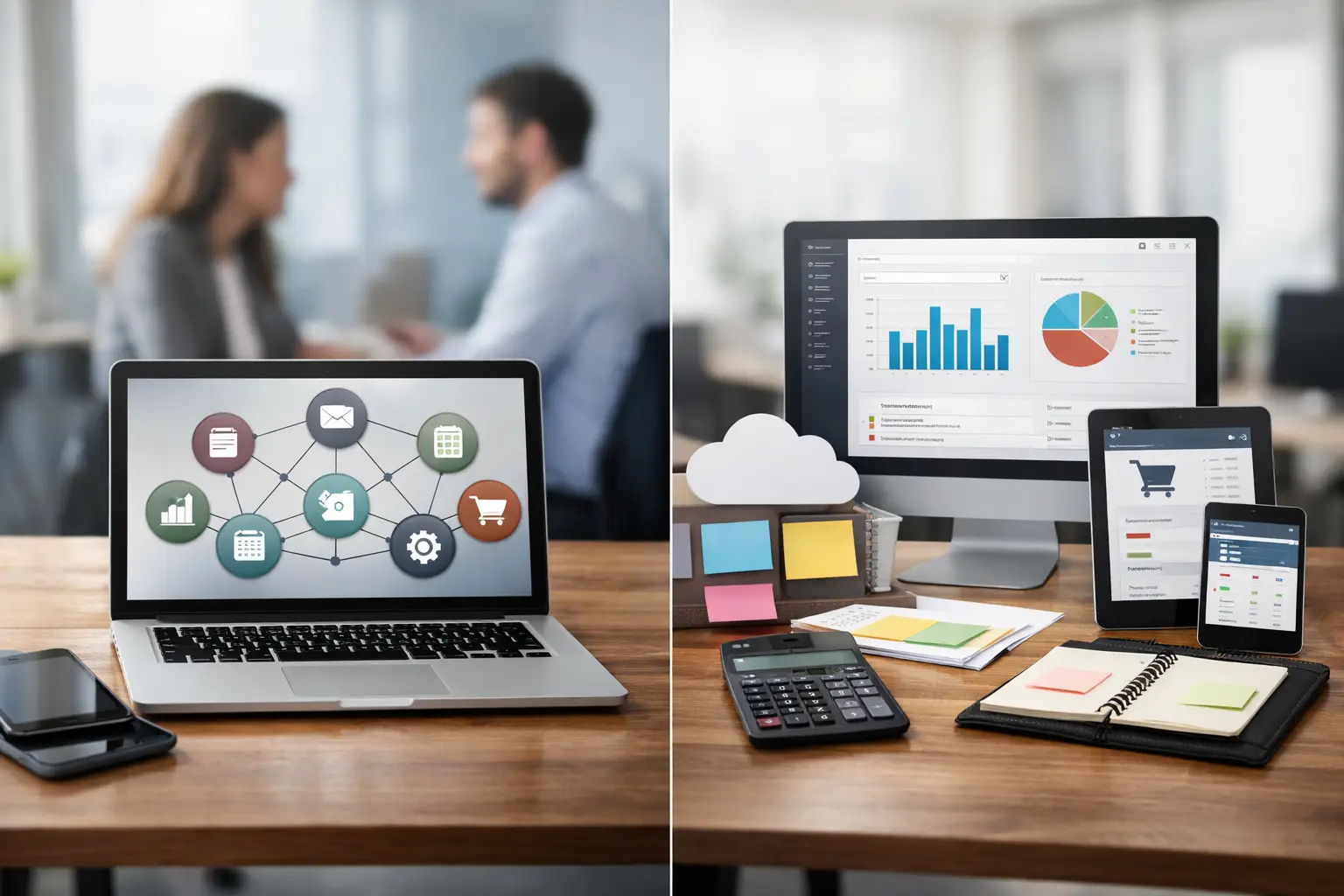
The core problem usually surfaces during an executive board meeting with a simple question: How much saleable inventory do we actually have on hand, and how does it impact our cash flow? If answering this question requires extracting an Excel sheet from the warehouse, a financial statement from accounting, and recent messages from the sales team, the issue extends far beyond basic reporting. An operational comparison between Odoo and disconnected systems demonstrates that the real difference lies between chasing fragmented data and relying on a single source of truth that drives executive decisions.
Disconnected software systems may perform adequately during early-stage growth: standalone accounting software, an isolated Point of Sale (POS) application, a basic spreadsheet for customer tracking, a separate time and attendance tool, and an independent e-commerce storefront. However, as branch networks expand, order volumes increase, and headcount grows, these isolated tools evolve from quick fixes into layers of manual work, endless reconciliations, and operational risks.
Where Disconnected Systems Fall Short
Relying on disconnected systems does not mean individual software packages are inherently flawed. Each application may perform its specific function well. The breakdown occurs when business processes move across departments. A sales representative confirms an order in the CRM, the warehouse keeper sends a manual stock update, and the finance team waits for physical documents to issue an invoice and follow up on collections. Every manual handoff introduces potential delays, duplicate entries, and data discrepancies.
These operational gaps widen significantly when managing omnichannel business models. An e-commerce platform may display stock levels that do not reflect actual physical inventory on warehouse shelves. A retail branch might record a product return that is not posted to general ledger accounts immediately. A contracting project may purchase materials without linking costs directly to project cost centers. In restaurant and retail operations, delayed POS reconciliations turn waste management and profitability tracking into reactive post-mortems rather than real-time daily controls.
The impact goes far beyond overtime spent consolidating spreadsheets at month-end. Unintegrated systems lead to missing customer invoices, inaccurate stock counts, prolonged financial closes, conflicting departmental reports, and heavy dependency on specific individuals who know where historical data resides. When key staff members leave or operations scale, the fragile nature of this operating model is exposed.
Odoo vs. Disconnected Systems in Daily Operations
Odoo is a unified Enterprise Resource Planning (ERP) platform that connects core business workflows within a single, centralized database. This does not require activating every single application on day one. Instead, it ensures that all active modules operate within a shared data ecosystem. Growing enterprises can start with Sales, Invoicing, and Inventory, expanding seamlessly into Project Management, Manufacturing, or Human Resources as business priorities evolve.
Sales and Inventory Integration
In a disconnected software ecosystem, sales teams often sell products based on outdated inventory reports or isolated third-party platforms. The warehouse team then discovers the stock is already reserved for another customer or has not arrived from the supplier. This lack of alignment damages customer relationships, increases order cancellations, and leads to partial shipments.
In Odoo, sales quotations, confirmed sales orders, warehouse deliveries, and customer invoices are directly linked to real-time inventory movements. When properly configured, management gains full visibility over available-to-promise inventory, incoming purchase orders, reserved stock, and product movement histories. E-commerce platforms, POS terminals, and third-party logistics carriers integrate into a single workflow that eliminates duplicate data entry.
However, software unification cannot substitute for operational discipline. If units of measure are inconsistent or procedures for goods receipts, stock counts, and customer returns are poorly defined, errors will persist within the unified ERP. The difference is that Odoo exposes the root causes of operational friction immediately and allows management to build preventive internal controls.
Financial Governance and Regional Compliance
In disconnected environments, month-end closing relies heavily on manual consolidation: exporting sales reports, reconciling payment gateways, posting manual journal entries, and cross-checking vendor bills from multiple sources. As transaction volumes grow, the risk of discrepancies between operational activity reports and audited financial statements increases significantly.
Connecting Sales, Procurement, Inventory, and Expense Management directly to Odoo Accounting automatically translates daily operational events into auditable journal entries according to corporate policies. This accelerates month-end financial closing and equips finance leaders with real-time insights to analyze profitability and cash flow by customer, product line, project, or branch.
For enterprises operating in Saudi Arabia, compliance must be built directly into workflow design rather than added as an afterthought. Mandatory requirements—such as ZATCA e-invoicing compliance, VAT reporting, approval hierarchies, and document retention—require precise configuration aligned with actual business practices. Native integrations matching ZATCA e-invoicing requirements minimize manual intervention while enforcing strict financial compliance.
Human Resources, Project Management, and Professional Services
The value of a unified ERP platform is particularly evident in service-oriented businesses and contracting firms. When field employees log billable hours in a standalone time-tracking tool while project contracts, vendor bills, and client invoices are managed across separate systems, measuring true project profitability becomes guesswork. A project may appear profitable on a sales report while incurring losses once actual labor, materials, and overhead expenses are accounted for.
Odoo unifies project tasks, timesheets, vendor bills, and client invoicing within a single operational cycle. For organizations tracking employee attendance, physical time clocks integrate directly with HR records and payroll processing according to company policies. The primary objective is optimizing resource allocation and accurately calculating service delivery costs rather than simple employee monitoring.
Why System Unification Is More Than an IT Decision
Deploying a unified ERP platform does not automatically fix undefined operational procedures. If internal approvals rely on unrecorded chat threads, discount limits are unenforced, or retail branches follow inconsistent inventory policies without justification, migrating to an ERP will expose operational chaos rather than resolve it.
Successful ERP implementations begin with a comprehensive GAP analysis that evaluates current operational workflows against targeted business processes. Implementation teams must determine what requires standardization, where operational flexibility is needed, and which data must be cleaned prior to system migration. Addressing these core questions prevents unnecessary software customization and establishes a practical implementation scope that can be deployed effectively and scaled over time.
Custom development has its place—especially when a business operates a unique business model or must comply with specific regulatory mandates. However, customizing every detail simply to mirror legacy procedures increases implementation costs and complicates future software upgrades. The optimal approach is adopting standard Odoo workflows wherever possible and reserving custom development for functionality that delivers genuine operational advantages.
When Are Disconnected Systems Still Acceptable?
Not every enterprise requires an immediate full-scale ERP deployment. Early-stage startups with simple operations, or small teams offering a single service without physical inventory, multiple branches, or complex financial cycles, can operate effectively using specialized standalone tools. Furthermore, niche third-party applications may remain part of an enterprise architecture post-Odoo deployment—provided robust API integrations ensure smooth data flow without manual re-entry.
The decision to unify systems should not be based on the number of software tools in use. Instead, evaluate how often employees re-enter identical data, how long it takes to generate reliable management reports, and whether executive leadership can track an order from lead creation to cash collection. When obtaining accurate answers requires manual labor or relies on key personnel, unifying systems becomes an urgent operational priority.
A Practical Roadmap for Migrating to Odoo
A successful transition to Odoo does not involve activating every module at once. The migration begins by identifying high-risk or costly bottlenecks—such as inventory variance, delayed financial closing, procurement inefficiencies, or collection delays. Existing workflows, approval checkpoints, master data structures, and required third-party integrations must then be thoroughly documented.
Next comes system configuration and data migration. Historical data varies in operational value; cleaning and migrating active customer master files, vendor records, opening balances, and active product catalogs takes priority over importing legacy transaction logs without data cleansing. Comprehensive end-to-end testing must cover real-world scenarios—such as partial deliveries, customer returns, custom discounts, tax invoices, and inter-warehouse transfers—prior to go-live.
End-user training is a core phase of implementation, not an afterthought. Employees must understand how their daily tasks evolve within Odoo, why specific data fields are required, and who holds approval authority for each step. Post-go-live functional and technical support ensures smooth exception handling, continuous report optimization, and system refinements based on actual usage.
Global Solutions serves as a specialized Odoo implementation partner—guiding enterprises through operational GAP analysis, custom development, API integrations, data migration, user training, and long-term support. This structured approach helps growing businesses align Odoo with actual operating models while integrating e-commerce storefronts, 3PL logistics providers, POS hardware, biometric attendance tools, payment gateways, and local regulatory mandates.
Making the Strategic Decision
Rather than simply asking "Do we need Odoo?", ask: Which executive decisions are currently delayed because operational data is fragmented across separate tools? Identify the primary operational cycle impacting revenue, cash flow, or customer satisfaction, assign clear process ownership, and build system unification around that core workflow. This transforms an ERP deployment into a strategic foundation for sustainable growth rather than an isolated IT project.