



When a single order fulfillment is delayed, the root cause is rarely just a physical shelf, an individual employee, or a shipping courier. More often, it is the direct result of fragmented operations spanning sales, inventory management, purchasing, and delivery. This Odoo Logistics Review provides a practical evaluation of what the system can actually handle out-of-the-box, versus what requires thoughtful design and careful implementation before it can become a reliable operational platform.
Odoo is not a standalone logistics software in the narrow sense; rather, it is an Enterprise Resource Planning (ERP) platform that integrates warehouse management with sales, purchasing, accounting, manufacturing, and customer service. This integration represents a vital strength for organizations seeking to connect physical inventory movements directly to financial and commercial outcomes, rather than simply tracking stock quantities in isolation.
What Does Odoo Cover in Logistics Operations?
Value creation begins with inventory management, where users can define multiple warehouses, internal locations, receipt zones, packing areas, and shipping docks. The system supports reordering rules, movement routes, inter-warehouse transfers, periodic physical inventories, and batch or serial number tracking. Consequently, a distribution company can receive goods in a designated dock area, route them through quality inspection when necessary, and transfer them either to bulk storage or order-packing zones according to predefined rules.
These operations tie automatically into sales and purchase orders. Upon confirming a sales order, the system generates the required delivery operation, displays real-time stock availability, and—depending on procurement configurations—can automatically trigger purchase or manufacturing orders if stock is insufficient. This connectivity reduces reliance on manual spreadsheets and repetitive internal communications, though it does not eliminate the need to establish clear inventory policies, approval workflows, and team responsibilities.
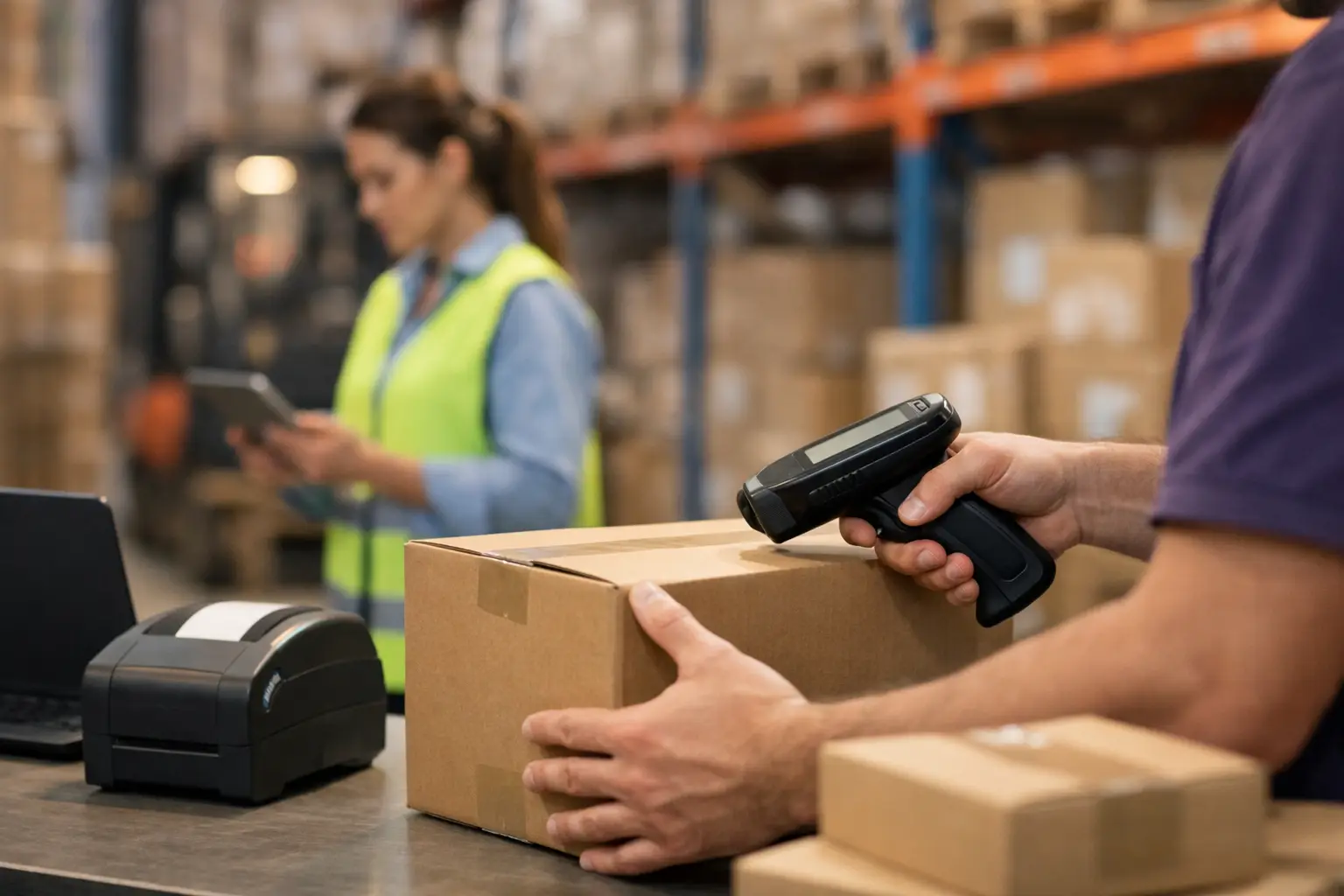
Odoo also supports barcode scanning to accelerate receiving, picking, packing, inventory counts, and internal transfers. In high-volume transaction environments, barcode scanning significantly enhances execution accuracy, provided organizations select appropriate hardware and design barcode labels and location layouts logically. Conversely, establishments processing a limited number of daily orders can successfully leverage the system without heavy upfront investments in specialized equipment.
Odoo Logistics Review According to Business Needs
Implementation outcomes vary widely depending on the underlying business model. A warehouse serving an e-commerce store and processing hundreds of shipments daily requires clear picking priorities, direct integration with shipping carriers, and real-time order status updates. Conversely, a construction contractor demands stringent controls over material transfers between a central warehouse and various project sites, linking stock issuance directly to project line items and budgets.
Multi-Warehouse Management
Odoo provides a robust foundation for managing multiple warehouses, allowing organizations to assign unique supply rules to each location. For instance, a business can allocate one warehouse for direct retail sales, another for e-commerce, and a third for raw materials. Furthermore, routing rules can support internal stock transfers or fulfillment from an alternate warehouse when stock depletes locally.
However, expanding routing complexity should never become an objective in itself. Excess virtual locations and unnecessary workflow steps often confuse users and increase transaction errors. The ideal design mirrors physical goods movement on the shop floor, introducing control points only when they deliver clear operational or audit value.
Traceability, Quality, and Expiry Management
For sectors handling sensitive products—such as food and beverage, automotive spare parts, and medical supplies—batch and serial number tracking enables complete visibility over product origins, movements, and destinations. Expiry date tracking and FIFO/LIFO removal policies help minimize waste, while customizable quality control or quarantine steps can be enforced upon receipt.
These capabilities prove invaluable when processing customer returns, managing complaints, or executing product recalls. Instead of wading through scattered records, teams can instantly isolate affected batches and identify impacted customers. Nevertheless, data reliability hinges entirely on warehouse staff adhering strictly to barcode scanning and digital logging at every operational checkpoint.
Shipping and Delivery
Odoo integrates seamlessly with shipping carrier services to calculate delivery costs, generate shipments, retrieve tracking numbers, and update delivery statuses. These integrations become increasingly crucial when operating multi-channel sales platforms, as fulfillment teams avoid manually re-entering delivery addresses and order data across multiple carrier portals.
Nevertheless, organizations should not assume that every global carrier or local courier service is natively supported in the exact same manner. Implementation teams must verify API integration capabilities, city coverage, rate calculation logic, return management workflows, and cash-on-delivery (COD) handling early in the project lifecycle. Certain scenarios may necessitate custom development or middleware integration, particularly when local operational nuances are involved.
Where Does Odoo Excel, and Where Does It Require Attention?
Odoo’s true strength emerges when management requires unified visibility: what was sold, what is available, what has been shipped, what needs to be purchased, and the financial impact on costs and revenues. Instead of passing data back and forth between accounting software, storefront platforms, and isolated inventory spreadsheets, cross-functional teams collaborate on interconnected data within a single operational cycle.
Moreover, customization flexibility empowers organizations to align workflows, approval hierarchies, and reporting layouts with their standard operating procedures. However, this flexibility introduces a double-edged sword: undisciplined customization complicates software upgrades, drives up maintenance overhead, and ties core operations to bespoke code understood by only a handful of individuals. The practical golden rule is to adopt standard configurations wherever possible, reserving customization strictly for features that yield a genuine competitive advantage or satisfy uncompromisable regulatory mandates.
Data quality at project inception represents another critical risk area. Migrating duplicate item master records, inconsistent units of measurement, and unverified stock balances guarantees inaccurate reporting, regardless of system capabilities. A successful warehouse project cannot rely solely on importing a legacy item list; it requires rigorous data cleansing, a clear coding structure, baseline opening balance reviews, and realistic end-to-end operational testing prior to go-live.
How to Evaluate System Suitability Before Implementation
Sound evaluation begins with an operational gap analysis rather than a generic software screen demonstration. Project teams must document the complete order lifecycle—from order entry through cash collection or return processing—pinpointing manual data entry bottlenecks, processing delays, and information drop-offs. Only then should teams decide which processes to automate in Phase 1 and which to defer to avoid disrupting the initial launch.
Four key questions help uncover major implementation risks early:
- Do warehouse locations and movement paths reflect the actual physical flow of goods, or merely a theoretical concept?
- Are item master data, units of measurement, batch records, and current stock balances cleaned and ready for review and migration?
- Do sales channels, shipping carriers, and POS systems require out-of-the-box integrations or custom development?
- Does every system user clearly understand what they must log into the system, when to do so, and how their actions affect downstream teams?
Clear answers to these questions establish realistic project scopes while preventing a common and costly mistake: attempting to launch every single module and third-party integration simultaneously before core operations stabilize.
Implementation That Preserves Business Continuity
Effective implementation typically follows a structured roadmap: gap analysis, workflow configuration, data migration, integration setup, user acceptance testing (UAT), training, go-live, and ongoing support. Organizations must never treat user training as a generic introductory session; a warehouse receiving clerk requires training scenarios starkly different from those of an inventory auditor, operations manager, or customer service representative.
User acceptance testing (UAT) is especially vital in logistics. Teams must test partial receipts, stock shortages or damages, internal transfers, out-of-stock orders, cancellations, customer returns, and multi-batch fulfillments. Testing restricted strictly to ideal, flawless scenarios breeds false confidence ahead of production deployment.
Partnering with an implementation provider possessing deep expertise across logistics, sales, and accounting workflows significantly compresses timelines and mitigates risks, particularly in multi-system environments. Global Solutions delivers an integrated delivery path encompassing gap analysis, execution, customization, integrations, data migration, user training, and structured helpdesk support—anchoring the project to post-launch operational success rather than just initial deployment configurations.
The Practical Decision
Odoo is an ideal choice for businesses seeking to unify inventory, shipping, sales, and finance within a single scalable platform. It proves most compelling when the primary pain points stem from data silos, fragmented toolsets, and departmental blindness, rather than a superficial desire to print shipping labels.
Begin by mastering a single core operational cycle—such as goods receipt through customer order delivery—and build your master data, routing rules, integrations, and training around it. When software configurations align seamlessly with real-world team workflows, logistics transforms from an operational burden into a powerful engine of control and speed.