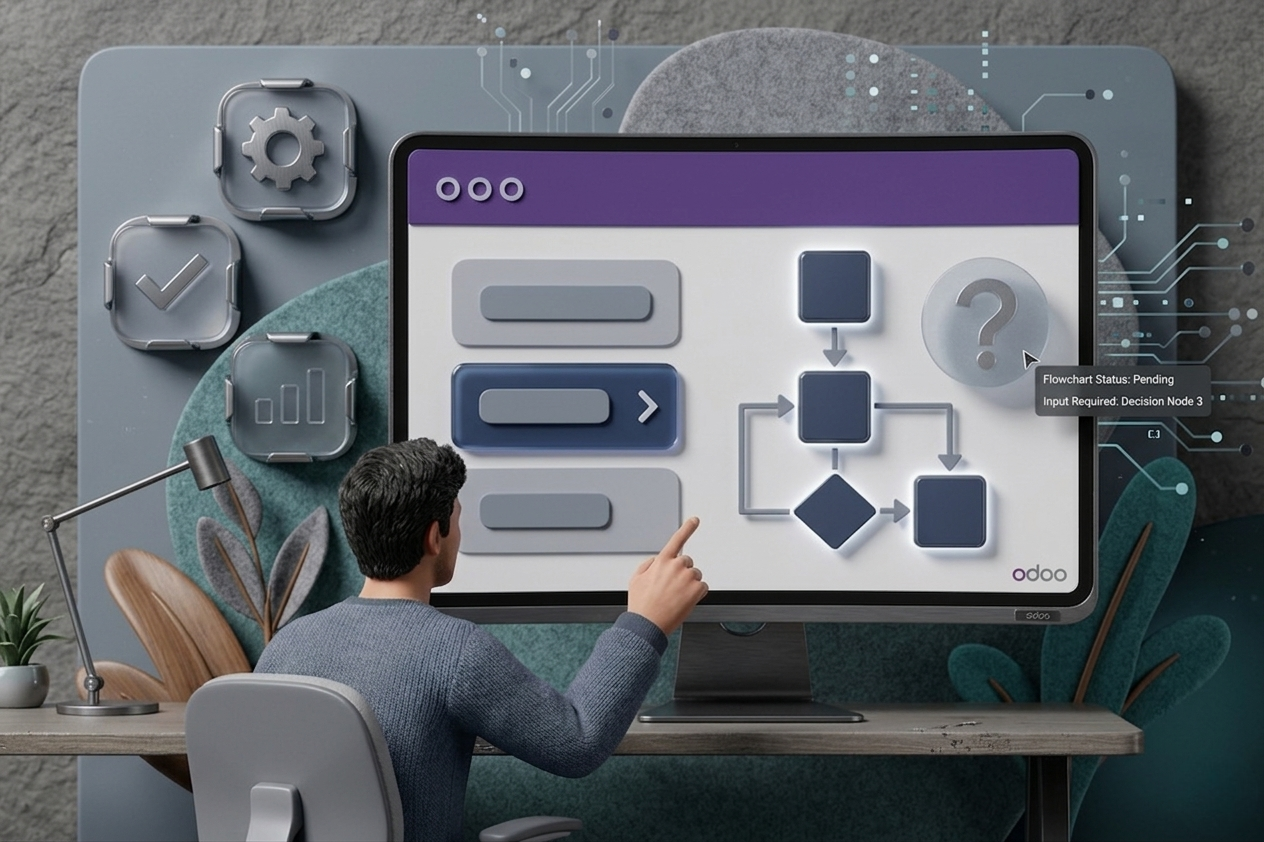
Imagine the end of the month — finance is chasing invoices from the sales team, inventory says the numbers do not match, and operations rely on Excel files where no one knows which version is the latest. The problem is usually not the people; it is that the systems are scattered: an accounting program here, a point-of-sale system there, and purchase requests buried in email threads.
This is where a question many decision-makers ask comes in: what is Odoo ERP for businesses, and can it truly bring all of this together in one place without turning the project into a burden?
What is Odoo ERP for Businesses?
Odoo ERP is an enterprise resource planning system built on interconnected applications (Apps) that cover the core functions of a company — such as sales, purchasing, inventory, accounting, human resources, manufacturing, projects, and customer service. The idea is not to buy one massive software system and force your business to adapt to it. Instead, the idea is to build a unified operational platform that starts with the essentials and expands as needed.
For mid-sized companies in particular, the value of Odoo appears when you need to unify the entire business cycle. A simple example: a quotation becomes a sales order, then a shipment from inventory, then an invoice from finance, followed by payment collection — with each step automatically reflected in reports without duplicate data entry. This is the core idea of ERP: a single source of truth for data instead of multiple versions and conflicting numbers.
Why Do Companies Choose Odoo Instead of Multiple Systems?
The most common reason we see in the market is that growth reveals hidden chaos. At the beginning, a company may succeed with standalone accounting software, Excel sheets, and various SaaS tools. But as branches increase, sales channels expand, or compliance, taxes, and operational auditing become necessary, that initial “flexibility” turns into a daily operational cost.
Odoo helps because its applications are designed to integrate within the same platform. When the same customers, products, chart of accounts, and pricing policies are shared across departments, data entry errors decrease and transaction cycles accelerate. However, it is important to be clear: unifying systems does not eliminate business complexity itself — it simply gives you better control and greater transparency.
How Odoo Actually Works Across Departments
The best way to understand Odoo is to think of it as a workflow across departments rather than separate modules.
Sales and Customer Service
The sales team needs to track opportunities, quotations, contracts, and delivery timelines. In Odoo, the same data flows directly into invoicing and logistics without being recreated. If you have different pricing policies depending on customer type or sales channel, or structured discount rules, they can be configured as part of your operational processes rather than handled as individual exceptions.
Purchasing and Inventory
As sales grow, inventory mistakes become expensive: unexpected stockouts, excess stock, or delayed deliveries. Odoo connects purchase orders with inventory levels, reordering rules, and batch or serial tracking when required. This is where the difference between a simple inventory system and an ERP becomes clear — purchasing is driven by actual operational demand rather than isolated manual decisions.
Finance and Accounting
Finance departments are usually the first to push for ERP because reports must be accurate and timely. Odoo supports the financial cycle from journal entries and invoicing to reconciliations, collections, multi-currency handling, and period closing. However, successful financial management in Odoo depends heavily on proper setup of the chart of accounts, cost centers when needed, and correctly configured taxes and regulatory rules. If the foundation is weak, the reports may look impressive but fail to support real decision-making.
Projects, Services, and Human Resources
For service-based companies — consulting firms, contracting companies, maintenance providers, or membership-based businesses — linking projects to billing, time tracking, and expenses provides immediate visibility into project profitability. In human resources, maintaining centralized employee data, attendance, and leave management while aligning them with company policies reduces manual follow-up tasks, provided that permissions and procedures are configured realistically.
What Makes Odoo Different from Traditional ERP Systems?
Odoo’s distinction is not simply that it is “popular” or “open source” as a marketing phrase. What matters to decision-makers is the impact on implementation and scalability.
First, Odoo allows you to start with a limited scope and gradually add applications later without rebuilding the system from scratch. This reduces the risk of launching a large ERP project all at once, provided the rollout is planned properly.
Second, the user interface resembles modern business applications, which improves adoption among teams — though it never replaces proper training.
Third, integrations often determine whether an ERP project succeeds or fails. Odoo can integrate with e-commerce platforms, shipping companies, point-of-sale systems, restaurant systems, attendance devices, payment gateways, and many other platforms. The key point is that integration should be implemented as part of the operational design, not merely as a technical connection.
Where Do Odoo Implementations Struggle?
If you have heard about ERP projects being delayed or failing, the issue is rarely that “the system is bad.” Most problems arise during execution.
The first common issue is turning the project into a simple data migration exercise. Moving customers, products, and historical invoices is important, but the real value lies in redesigning workflows so that measurement and control become part of daily operations.
The second issue is excessive customization. Sometimes customization is necessary because every business has unique processes, but every additional line of code increases maintenance costs and complicates future upgrades. The smart approach is to start with standard configurations and only customize what is truly essential.
The third issue is ignoring change management. Employees will not embrace a system simply because it is an ERP. They will adopt it when it saves them time, reduces repetitive questions, and provides clear operational steps. Achieving this requires training, clearly defined roles and permissions, and a structured post-go-live support plan.
What Should a Company Prepare Before Choosing Odoo?
The decision should not begin with a list of modules. It should begin with operational reality.
Ask yourself: where does duplicate data entry happen? Where do teams spend time reconciling numbers between departments? Which reports cannot be fully trusted? What breaks down when one person — the one who “knows the Excel file” — is absent?
These questions reveal the real pain points that ERP should solve.
After that comes the role of Gap Analysis — comparing current processes with how they should operate within the system. This stage defines scope, priorities, regulatory requirements, and required integrations. It significantly reduces surprises during implementation and prevents uncontrolled scope expansion.
What a Professional Odoo Implementation Looks Like
ERP implementation is not software installation. It is an operational project.
It usually begins with discovery and identifying the target processes, followed by system configuration design, then data preparation and cleansing before migration. Next comes building integrations and interfaces, conducting user acceptance testing (UAT) based on real scenarios, training teams, and then launching with close operational support during the first weeks.
If your company depends on external platforms — such as an online store, shipping companies, POS systems, or payment gateways — these requirements must be included from the beginning because they directly affect pricing, taxes, inventory, and order confirmation workflows.
This is where the role of the implementation partner becomes critical. The partner bridges two areas: understanding real-world operational workflows and activating, customizing, integrating, migrating, and upgrading the system without disrupting stability.
Based on many projects across different industries, companies that follow a full implementation path — from analysis to launch and then Training & Support through a helpdesk — typically realize value faster. For this reason, Global Solutions operates as a single delivery point for Implementation, Customization, Integrations, Data Migration, and Upgrade services, in addition to post-launch support and training, especially when operational integrations or regulatory compliance requirements are involved.
Is Odoo Suitable for Every Company?
Not always. If your company is very small, operations are simple, and there is little complexity in inventory, invoicing, or sales channels, ERP might be larger than necessary — or you might begin with a very limited scope.
On the other hand, if your company is a large enterprise with hundreds of entities and deeply customized legacy systems, the evaluation must be more thorough. Odoo may still be suitable, but implementation will be larger and require strict governance.
The most common fit is businesses with 3–10 interconnected functions that require a single source of operational data: sales, purchasing, inventory, finance, HR, projects, or light to medium manufacturing.
How to Measure Odoo Success After Go-Live
Success is not simply “the system works.” Success is visible through clear indicators: reduced month-end closing time, fewer inventory discrepancies, faster order-to-cash cycles, unified reports that decision-makers trust, and the ability to open a new branch or channel without multiplying operational chaos.
The most important sign of success is when operations no longer depend on specific individuals manually fixing data. The system becomes the natural way the company operates.
A Final Thought Before Making Any Decision
If you want to know whether Odoo will bring real value to your company, do not ask: “Does the system have every feature?” Instead ask: “Are we ready to unify how we operate and measure it?”
ERP does not create discipline from nothing — but it strongly rewards companies that want structured operations, reliable data, and an implementation partner committed to results, not just delivery.