When sales numbers differ between the branch, warehouse, and financial reports at the end of the day, the issue is often not with Odoo itself, but with the lack of the right integrations around it. That’s why choosing the best Odoo integrations for the retail sector should not be measured by the number of connected systems alone, but by their ability to reduce losses, unify data, and accelerate operational decisions from front-end to back-office.
What Makes an Odoo Integration Successful in Retail?
The retail sector cannot tolerate delays in data synchronization. Any discrepancy between actual stock and system stock directly impacts sales, customer experience, and purchasing plans. Therefore, a successful integration is not just a technical connection between two systems, but a fully designed operational workflow that considers branches, warehouses, returns, promotions, payment methods, and tax compliance.
In successful projects, the first question is: which operations must work in real time, and which can be updated in batches? Connecting POS systems to inventory requires fast synchronization to avoid selling unavailable products. On the other hand, some analytical reports may only need periodic updates. This distinction is important because it affects cost, complexity, and operational stability.
Top Odoo Integrations for Retail by Priority
POS Integration
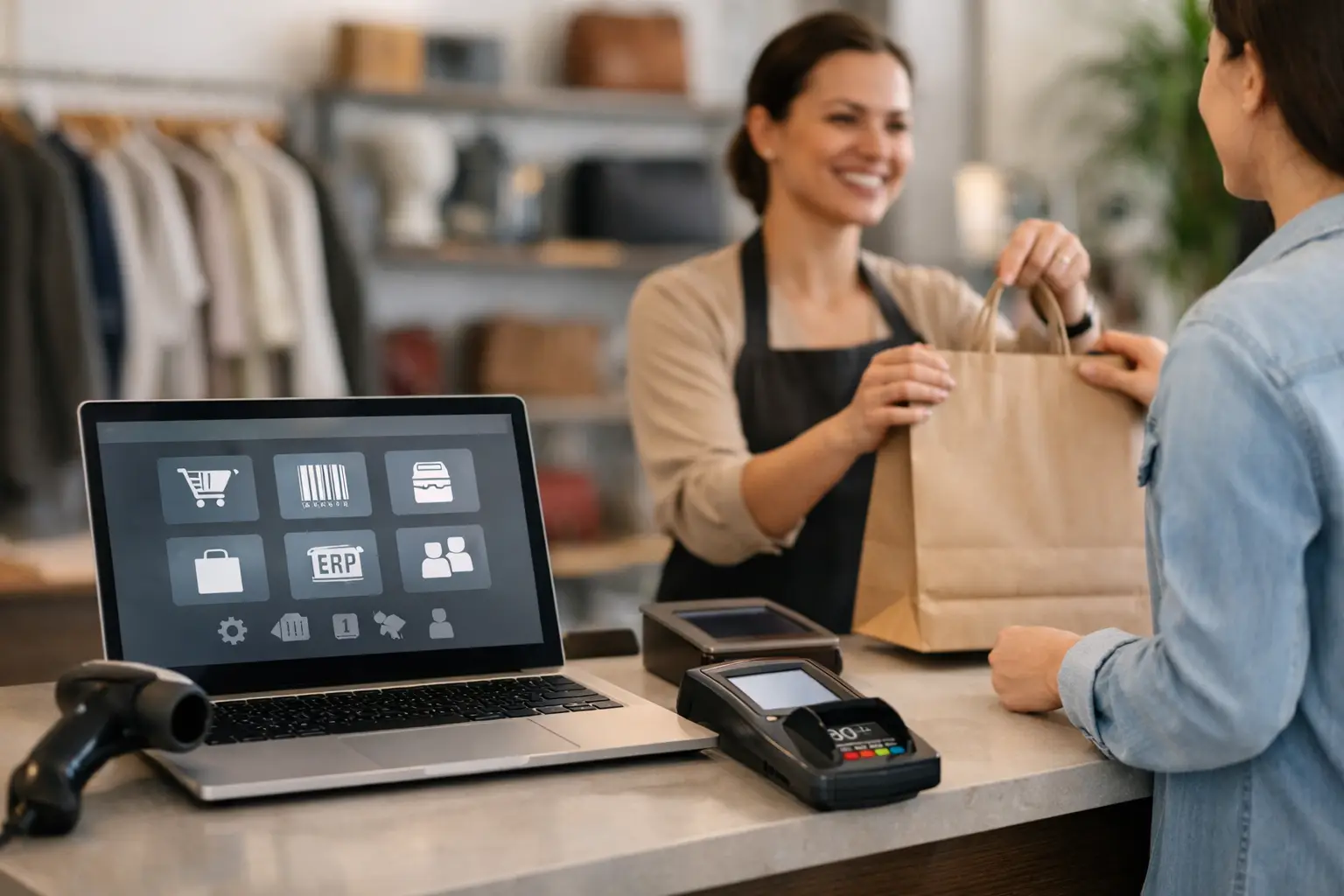
This is the most critical integration in a retail environment. If the company uses POS devices, barcode scanners, customer displays, and receipt printers, it is not enough for the POS system to work independently. Every sale, return, discount, and cash closing transaction must flow into Odoo in an organized and transparent way.
A strong POS integration delivers three immediate results: real-time inventory updates, accurate financial posting, and unified customer and loyalty program data when required. In multi-branch environments, this integration becomes even more valuable because management needs a centralized performance view instead of treating each branch as a separate system.
However, there is a practical trade-off here. Some businesses need offline-capable POS systems that synchronize later when the connection is restored. This works well in certain retail environments but requires stricter controls to avoid conflicts after synchronization. Fully real-time operation offers stronger control but depends on stable connectivity.
eCommerce Integration
If the business sells through an online store or mobile application, integrating Odoo with eCommerce platforms becomes essential rather than optional. The goal is not just receiving orders, but unifying catalogs, pricing, promotions, inventory, and customer data between online channels and physical stores.
The biggest challenge in these projects is usually inventory synchronization. Displaying incorrect stock quantities online leads to canceled orders, delivery delays, and increased pressure on customer service. That’s why the best Odoo integrations for retail are those that make Odoo the central source of truth for products, inventory, and orders, with clear rules for product availability across channels.
In some cases, synchronizing everything in both directions is not the smartest approach. It may be more efficient to manage pricing and promotions directly from the eCommerce platform while keeping inventory, orders, and invoicing inside Odoo. The right decision depends on operational scale, marketing complexity, and the structure of the operations team.
Payment Gateway Integration
Payments are highly sensitive because they directly impact revenue. Any delay or mismatch in transaction reconciliation leads to accounting discrepancies, pending orders, or customer complaints that are difficult to trace. Therefore, payment gateway integrations with Odoo must follow a clear cycle starting from payment confirmation and ending with bank reconciliation and financial settlement.
The real value here is not just accepting payments, but linking payments to orders, invoices, returns, and refunds. When the business operates across multiple branches or sales channels, this integration becomes an important financial control layer, especially when settlements must be separated by branch, activity, or channel.
From a practical perspective, some gateways are technically easier but operationally less suitable, while others are the opposite. This means payment gateway selection should not depend only on transaction fees. Businesses should also evaluate settlement speed, reporting clarity, refund handling, rejection management, and compatibility with Odoo workflows.
Shipping and Logistics Integration
In modern retail, the customer journey does not end at checkout. Shipping, tracking, and delivery management have become part of service quality. When Odoo integrates with shipping providers, businesses can automatically create shipments, print labels, track statuses, and link shipping costs directly to orders or invoices.
This integration is especially important for companies operating both physical branches and eCommerce warehouses. Without proper logistics integration, teams are forced to manually transfer data between platforms, increasing errors and slowing order fulfillment.
However, not every business requires the same integration depth. Some only need shipment creation and status updates. Others require intelligent routing rules based on location, order size, shipping company, or delivery windows. Integration design should therefore reflect the actual operational model rather than applying a generic technical connection.
E-Invoicing and Compliance Integration
In Saudi Arabia, compliance is not an operational option that can be postponed. Any issue with e-invoicing or regulatory requirements creates financial, operational, and legal risks. That’s why one of the most important Odoo integrations for retail is connecting the system with ZATCA compliance solutions so invoices are generated according to regulatory standards without manual intervention that disrupts branch operations.
The importance of this integration increases significantly in high-volume retail environments where invoice speed and consistency are essential. If each branch handles invoicing differently, discrepancies will appear in formatting, reporting, and auditing. But when compliance is embedded directly into the Odoo workflow, oversight becomes clearer, audits become easier, and risks are reduced.
Barcode, Scale, and Printing Device Integration
These integrations may appear small, but they directly affect operational speed inside stores and warehouses. Connecting Odoo with barcode devices, printers, and weighing scales reduces manual entry errors and improves inventory accuracy, receiving, and stock transfers.
In sectors such as food retail, FMCG, and weight-based products, these integrations are not optional. Any delay or error in product definitions, weights, or labeling immediately affects pricing, accounting, and inventory simultaneously.
How to Choose the Right Integrations Without Overcomplicating the Project
One of the most common mistakes is trying to integrate everything from day one. This increases project cost, extends implementation time, and raises the risk of operational failures during go-live. A more effective approach is prioritizing integrations based on their impact on revenue, control, and operational continuity.
Start with integrations that eliminate the most expensive manual work: POS, inventory, payments, and compliance. Then expand into eCommerce, shipping, loyalty systems, or marketing tools depending on your business model. This phased approach does not reduce ambition; it protects the project from unnecessary complexity.
It is also important to distinguish between ready-made integrations and custom integrations. Ready-made integrations are usually faster and less expensive but may not fit every operational scenario. Custom integrations offer more flexibility for unique workflows but require deeper analysis, stronger testing, and ongoing post-launch support. The right decision depends on how unique your operations are, not simply on a preference for customization.
When Is Odoo Enough on Its Own and When Are Additional Integrations Necessary?
Odoo provides a strong foundation for sales, inventory, purchasing, accounting, and POS management. However, in retail environments, operations are rarely fully centralized within a single system. Businesses often rely on payment providers, shipping companies, eCommerce platforms, hardware devices, and local compliance systems. This is where integrations become part of the operational backbone rather than secondary add-ons.
If your business has limited channels and only a few branches, you may be able to manage most operations directly inside Odoo with minimal integrations. But if you operate multiple branches, online sales, frequent stock transfers, and complex financial settlements, integrations shift from operational improvements to management necessities.
What Should You Verify Before Approving Any Integration?
Before approving any integration, ask four practical questions: where does the data come from, when does it update, who monitors the errors, and how will the service continue after go-live? Many projects succeed during demos but struggle later because exception scenarios were not properly addressed, such as duplicate orders, partial returns, connection failures, or unit-of-measure mismatches.
Post-launch support is just as important as development itself. A strong integration requires monitoring, updates, and testing whenever connected systems change or when upgrading to a new Odoo version. This is why serious companies prefer working with implementation partners who provide Implementation, Customization, Integrations, Training, and Support within one unified delivery model instead of splitting responsibilities across multiple vendors.
In retail projects, value does not come from the number of connected systems, but from operational clarity after integration. If you want unified visibility over sales, inventory, collections, and compliance, start with the integrations that support daily operational decisions first, then expand your ecosystem on a stable foundation. That is the fastest route toward more accurate operations and scalable growth.