When payment reconciliation is delayed even by a single day, the impact quickly appears in cash flow reports, customer follow-ups, and collection scheduling. This is where integrating Odoo with the SADAD payment gateway in Saudi Arabia becomes an operational necessity rather than just a technical option. Companies that handle recurring invoices or rely on sensitive collection cycles need payment status visibility directly inside their ERP system, not through manual checks across multiple platforms.
Odoo is naturally a flexible ERP platform, but its real value appears when it is connected to the local Saudi business ecosystem. With SADAD integration, the process goes beyond simply sending payment requests. It extends into managing the full collection lifecycle — from invoice generation and payment tracking to accounting entries and operational reporting. This type of integration reduces gaps between finance, sales, and customer service teams while giving management clearer visibility into liquidity and actual collections.
What Does Odoo Integration with SADAD Mean in Practice?
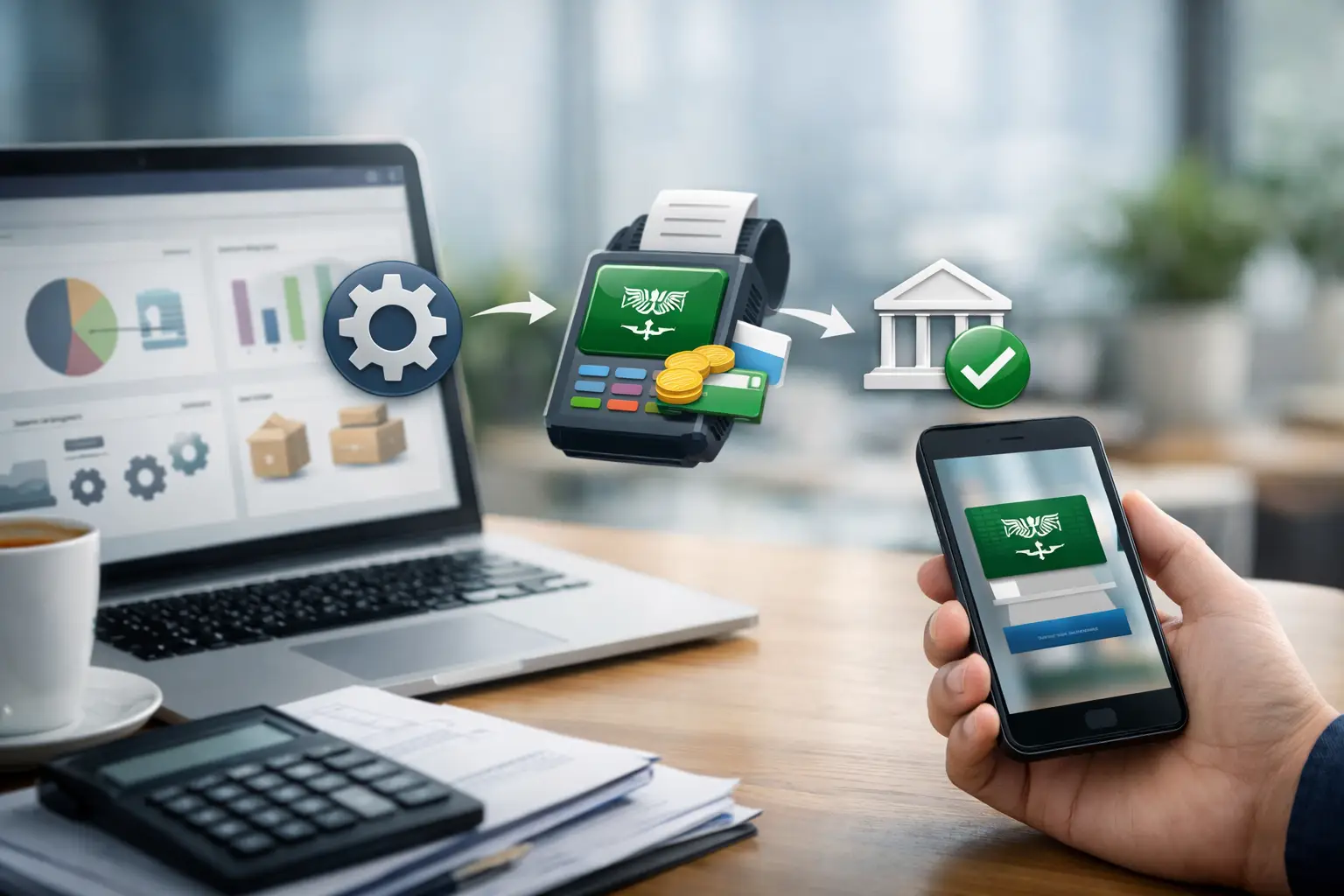
In practical terms, the integration connects customer invoices and payment requests inside Odoo with SADAD’s payment system so that invoice references, payment amounts, payment status, and transaction results flow automatically between both platforms. The benefit is not only faster collections, but also fewer errors caused by manual entry or delayed verification.
For businesses processing thousands of invoices or serving enterprise customers, issuing invoices alone is not enough. The workflow must include payment request generation, reference management, payment confirmation, invoice status updates, and accurate accounting reflection inside the ERP.
Where Does the Real Operational Value Appear?
The first advantage is control. Finance managers need visibility not only into issued invoices, but also into what has actually been collected, what is pending, and what requires follow-up. When Odoo becomes the central source for this information, manual reconciliation efforts decrease significantly.
The second advantage is responsiveness. Customer service and sales teams benefit from seeing payment status directly inside the customer record or invoice screen, reducing delays and preventing conflicting information between departments.
The third advantage is accounting accuracy. A successful integration should not stop at marking invoices as paid. It must support accounting workflows, reconciliation logic, partial payments, rejected payments, and refund handling when required.
When Does Integration Become a Priority?
For companies issuing only a few invoices per month, manual processing may seem manageable. But as transaction volume grows, the cost of manual operations increases rapidly. Monthly closing becomes slower, errors become more frequent, and receivables tracking becomes harder.
Integration becomes critical for businesses handling subscriptions, recurring billing, large customer bases, multiple branches, or centralized financial reporting requirements.
How Should Odoo Integration with SADAD Be Designed?
Integration should begin with understanding the business workflow, not with coding. The first question is: when should the payment request be generated? Upon invoice confirmation? After internal approval? Based on customer-specific rules?
After clarifying operational logic, the technical integration layer is designed. This includes defining data mappings, validation rules, error handling, retry policies, audit logs, and security controls.
Testing is equally important. Successful testing should cover not only ideal payment scenarios, but also exceptional cases such as canceled invoices, partial payments, duplicated requests, incorrect amounts, or temporary connection failures.
Common Integration Challenges
One common mistake is treating the integration as a purely technical project disconnected from operational teams. The result may be a connection that technically works but does not align with the company’s accounting or collection procedures.
Another challenge is poor data quality. If customer records or invoice references inside Odoo are inconsistent, the integration will replicate those issues rather than solve them.
Auditability and permissions also matter. In financial environments, businesses must clearly track who created payment requests, who modified them, when statuses changed, and how transactions were posted.
What Should You Expect from an Implementation Partner?
If you are evaluating an Odoo integration project with SADAD, do not only ask whether the integration is technically possible. The more important question is how the integration will align with your collection cycle and accounting processes.
A qualified implementation partner should begin with a gap analysis, define integration scenarios clearly, establish testing plans, and provide post-go-live support.
Experience in the Saudi market is especially important for companies with compliance requirements, complex invoicing models, or multi-department workflows.
Does Every Company Need the Same Integration Model?
Not necessarily. Some businesses require fully automated real-time synchronization inside Odoo, while others may only need a simpler integration depending on transaction volume and collection structure.
The level of customization also depends on chart of accounts structure, approval workflows, and whether collections are handled per invoice or at the customer account level.
What Ensures Stability After Go-Live?
The first factor is monitoring. Businesses need dashboards and reports showing successful transactions, pending cases, and errors requiring intervention.
The second factor is continuous support. Business needs evolve, workflows change, and collection processes may require future adjustments.
The third factor is training. Even the best integration loses value if users do not understand how to interpret statuses, manage exceptions, or differentiate operational errors from technical issues.
When implemented correctly, integrating Odoo with SADAD becomes more than just adding a payment channel. It creates a more reliable collection cycle, more accurate reporting, and stronger financial visibility across the organization.