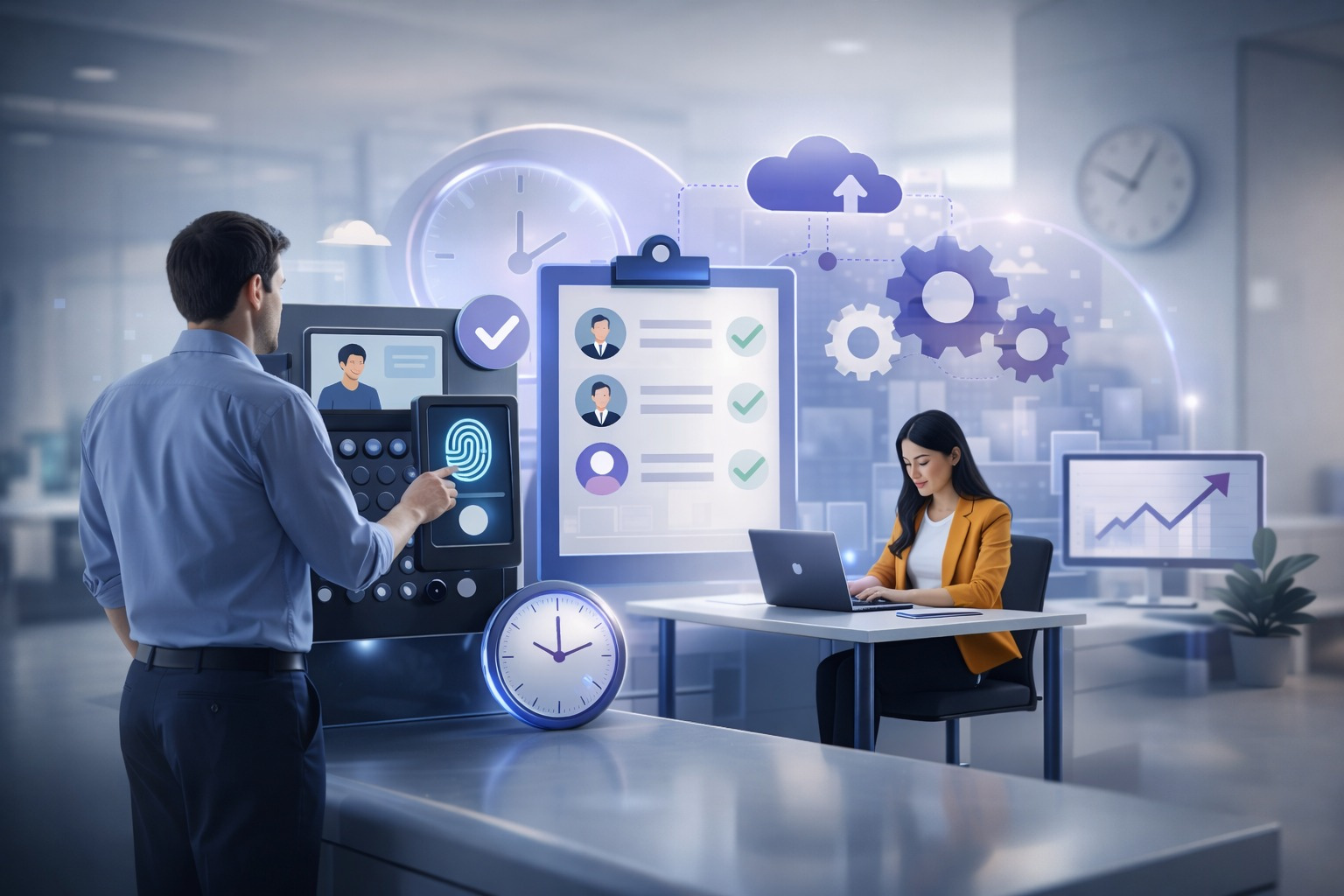



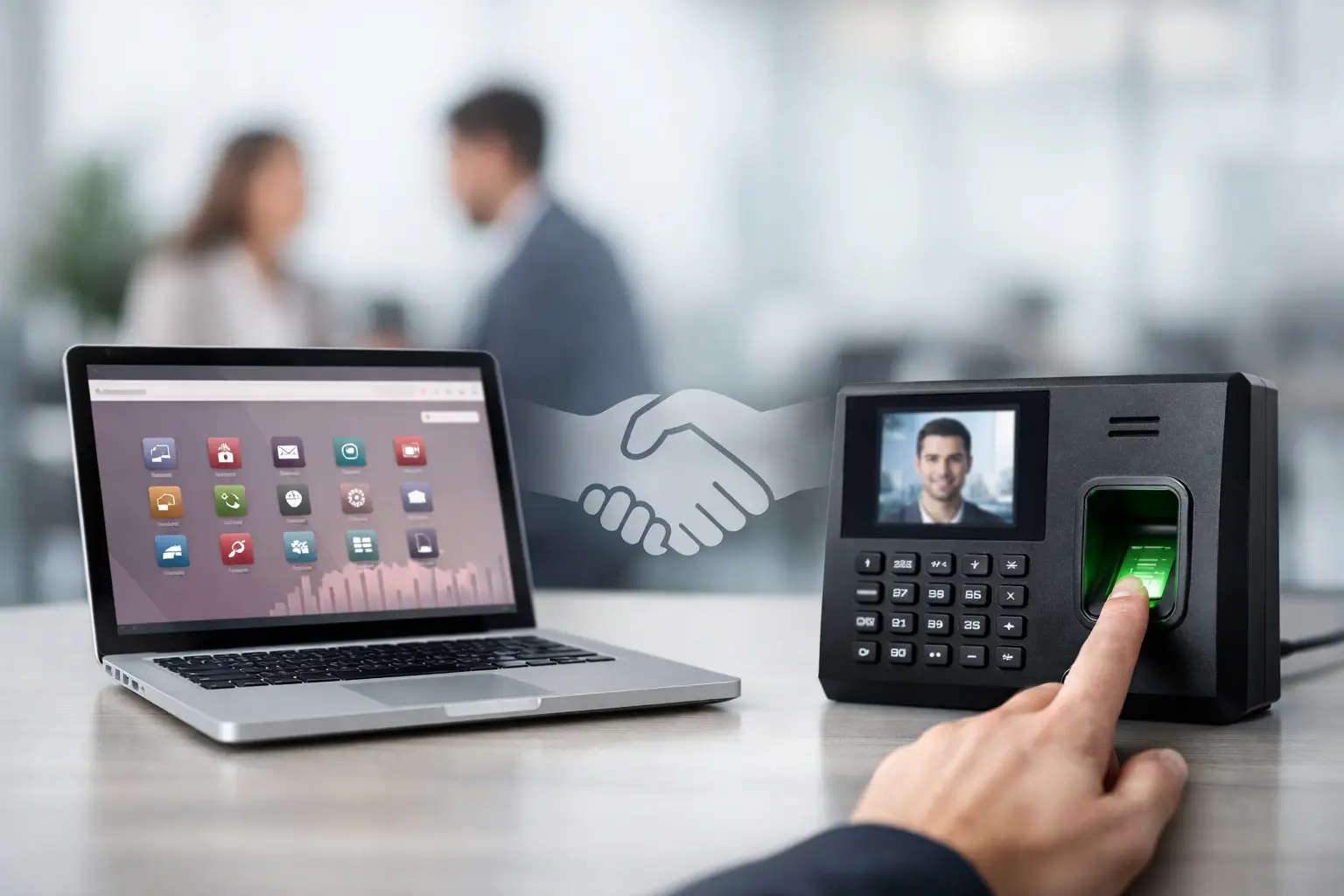
When the HR team relies on BioTime for time and attendance while payroll, leaves, and contracts are managed within Odoo, the problem begins in a place that seems simple—the same employee appears in two separate systems, working hours are reviewed twice, and any late adjustment can directly impact payroll. Here, the value of integrating Odoo with BioTime becomes highly practical, as it does not merely add a new tool but rather bridges a daily operational gap that impacts accuracy, time, and control.
What Does Odoo Integration with BioTime Actually Deliver?
The core concept is not just about moving biometric punch logs from one system to another. A well-designed integration connects the entire workflow, linking employee profiles, attendance schedules, check-in/check-out records, delays, overtime, and approved leaves. This data then seamlessly reflects upon subsequent processes within Odoo, such as payroll, reporting, and automated notifications.
In business environments spanning multiple branches or shifting schedules, the value of this connection multiplies. Instead of the HR team manually reconciling exceptions every month, attendance is handled as a live operational data source connected directly to the centralized system. This enhances data reliability, drastically cuts down review time, and reduces disputes over calculated hours.
When is Integration a Necessity Rather Than an Enhancement?
If your enterprise manages a limited number of employees in a single location with fixed working hours, manual processing might seem acceptable for a while. However, the situation shifts rapidly when multiple shifts, diverse locations, varying late-arrival policies, or a direct link to payroll enter the equation. At that stage, keeping BioTime and Odoo isolated becomes costly, even if the financial leak isn't obvious at first.
The clearest indicator is the repetition of corrections right before closing payroll. If your team is cross-checking Excel sheets, or exporting from BioTime and reformatting data before uploading it to Odoo, this is not just an extra operational step—it is a recurring point of risk. Every manual export opens the door to formula glitches, date errors, misspelled employee names, or incorrectly calculated exceptions.
How Does Odoo and BioTime Integration Work in a Real Operational Environment?
In practical application, integration typically starts by establishing a unified reference between both systems. Each employee must have a unique and matching identifier, alongside properly synchronized branches, departments, shifts, and attendance policies. Following this, the exchange mechanism is determined—whether it will be periodic synchronization every few minutes or hours, a batch process at the end of the day, or a hybrid logic based on operational needs.
Next comes the stage of translating events. BioTime records raw check-in and check-out events, whereas Odoo generally needs to interpret them within specific business rules. Is this punch a late entry or a shift swap? Is an early departure justified by an approved permission slip? Does overtime start after a specific threshold or only upon direct manager approval? These questions cannot be resolved by technical connectivity alone; they require designing business logic that aligns with corporate policies.
This is where the difference between a quick connection and a reliable integration becomes apparent. A link that merely transfers data might succeed technically, but it creates an administrative burden if it fails to respect internal regulations. Conversely, an integration built around operational workflows converts raw attendance data into comprehensive, dependable inputs within Odoo.
Data That Must Be Cleansed Prior to Implementation
Many project setbacks do not stem from the API itself, but rather from the quality of the baseline data. If employee names differ between systems, shifts are outdated, or late-arrival policies are enforced verbally rather than systematically, any integration will reflect this chaos instead of resolving it.
Before launching, it is vital to review the employee structure, their IDs, their distribution across branches, schedules, and recurring exceptions like field assignments or site-to-site commuting. A single source of truth for each data type must also be agreed upon. Are employee profile updates handled strictly through Odoo? Is BioTime the sole source for raw punch data while approvals and leaves remain anchored in Odoo? Defining these boundaries prevents downstream conflicts.
The Impact of Integration on Payroll and Internal Compliance
The most significant return on investment usually appears when connecting attendance to payroll. Instead of constructing a payroll cycle reliant on manual inputs and delayed corrections, the bulk of calculating active workdays, lateness, absences, and overtime can be automated according to approved policies. This does not mean payroll runs completely without human review, but it minimizes personal bias and increases consistency from month to month.
From an internal control perspective, the integration yields an important impact as well. When attendance records are inherently linked to the employee profile, leave approvals, and the resulting financial impact within the same system, auditing becomes far simpler. An executive director or operations manager no longer needs to compile reports from scattered sources to understand a spike in the company's overtime expenditure or recurring absenteeism at a specific site.
Common Challenges in an Odoo-BioTime Integration Project
One of the most frequent pitfalls is assuming that all attendance devices operate on the exact same logic or that all branches enforce a uniform policy. In reality, check-in and check-out mechanisms might vary from site to site, and there may be edge cases that standard settings cannot accommodate. Therefore, the project requires a clear gap analysis before execution, rather than just developing a basic data exchange interface.
The second challenge relates to synchronization frequency. Some enterprises require near real-time updates to monitor operational discipline, whereas others find periodic daily updates sufficient for payroll and reporting purposes. Choosing the right timing is not just a technical choice—it is a business decision tied to infrastructure costs, data volume, and the nature of system usage.
The third challenge is managing exceptions. Employees forgetting to punch, logging in from a different device, transitioning between two shifts, or conducting external assignments are all natural occurrences in daily operations. The success of an integration is measured by its capacity to absorb these cases within a clear approval workflow, rather than ignoring them or pushing them into unorganized manual handling.
What Should You Look For in an Integration Partner?
Priority should not merely be given to whoever can write the connection code, but to the team that deeply understands its combined impact on HR, payroll, and corporate reporting. A successful implementation begins with workflow analysis, followed by integration design, testing against real-life scenarios, and a gradual launch paired with user training. This is especially vital if the organization operates across multiple companies, branches, or mixed operational environments.
Attention must also be paid to maintainability. Any connection relying on complex, undocumented workarounds might function initially, but it turns into a vulnerability when updating Odoo, upgrading BioTime versions, or adding a new branch. The optimal choice is always building a clear, documented, and scalable integration, backed by a continuous technical support mechanism post-launch.
In enterprise projects, it is not enough for the integration to succeed in a sandbox environment. It needs to withstand the first payroll closure, the first modification to an attendance policy, and the first operational expansion. This marks the difference between a project delivered merely as a technical feature and one delivered as a complete operational solution.
Why Growing Enterprises Require a Unified Vision
As the number of employees or branches grows, decisions relying on data become increasingly sensitive. A minor delay in transferring attendance data can disrupt payroll, payroll directly impacts employee satisfaction, and employee satisfaction reflects heavily on operational stability. Therefore, a unified vision is not an administrative luxury; it is a core component of performance management and growth.
Odoo provides enterprises with a unified framework for HR, finance, and operations, but this value remains incomplete if vital primary data stays isolated in peripheral systems. This is where integrating Odoo with BioTime fits into a broader strategy to eliminate fragmented software applications and optimize daily decision-making accuracy.
For this reason, serious organizations tend to approach integration as part of a comprehensive project encompassing analysis, configuration, customization where necessary, testing, and training, alongside ongoing post-live support. This type of implementation aligns perfectly with business environments looking for scalable stability, and it is precisely what distinguishes experienced teams like Global Solutions when the requirement demands more than just a technical link.
When is Direct Integration Not the Best Immediate Option?
In certain scenarios, it might be wiser to postpone direct integration if attendance policies are highly volatile or if employee master data is in a state of severe disarray. Constructing an integration on top of an undisciplined process does not solve the underlying issue; it merely accelerates its movement between systems. The better approach here is to clean up the foundation first, then transition to the integration phase.
Additionally, some enterprises might require a transitional phase that combines partial synchronization with manual handling for specific highly unique cases, particularly if attendance rules are overly intricate or if devices are spread across remote sites with unstable connectivity. This is not a flaw in the solution, but a practical choice that protects the project from a rushed, premature launch.
Ultimately, the success of an Odoo integration with BioTime is not measured by the volume of records transferred, but by the enterprise's ability to rely on attendance data for daily decisions with greater confidence and less effort. When attendance becomes a living component of the workflow within Odoo, precision improves before the report is even printed, and the real impact manifests within operations before it shows up on a screen.