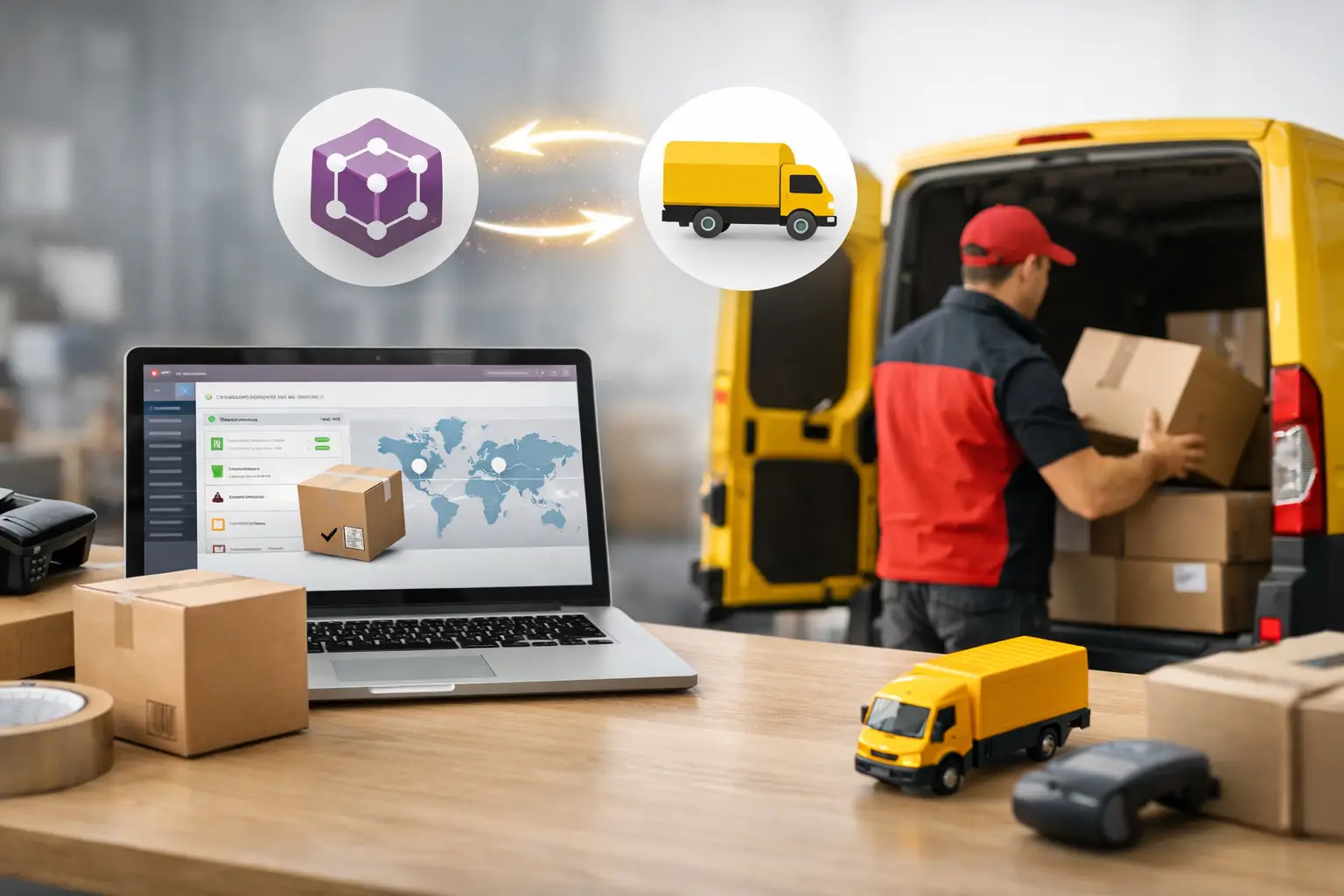
When preparing a shipment is delayed or operational teams are forced to enter customer details, weight, and addresses multiple times, the root problem isn't employee speed—it's the complete lack of integration. This is where the value of connecting Odoo with DHL becomes clear as a direct operational step that eliminates redundancy, linking sales, inventory, and shipping into a single, trackable, and auditable workflow.
For enterprises managing daily orders or transferring shipments across various cities and borders, having a powerful ERP system and a reliable shipping carrier in isolation is simply not enough. True business value is unlocked when creating a shipment, calculating costs, generating waybills, and updating delivery statuses turn into a single, interconnected process right inside Odoo. This depth of integration does more than just save time; it optimizes decision-making quality and gives management precise visibility over operational performance and logistics expenses.
Why the Odoo DHL Integration Matters In Practice
In many organizations, sales, warehouse, and customer service teams handle the exact same order but through fragmented tools. Sales confirms the order within the ERP, the warehouse picks and packs the items, and then the shipping team hops onto a separate platform to manually copy and paste data. This minor procedural gap triggers significant errors—ranging from outdated delivery addresses and incorrect weights to costly bottlenecks in printing shipping labels.
By establishing an Odoo DHL integration, the delivery order within Odoo serves as the master operational hub. Customer data can be extracted directly from the sales order, and product specifications or package weights can be pulled straight from the inventory module to generate the shipment instantly, completely removing manual re-entry. This reflects immediately on dispatch speed while reinforcing operational discipline, as every logistics movement remains explicitly tied to a single central record.
The most profound impact is felt by scaling businesses with growing order volumes. At inception, manual workarounds might seem manageable, but as shipping volumes climb, errors multiply exponentially, and tracking down the root cause of bottlenecks becomes a chaotic task. In this environment, system integration transitions from a technical luxury to a mandatory strategy for sustaining business growth without inflating administrative overhead.
What the Shipping Integration Typically Covers
A properly structured integration goes far beyond adding a basic button to push order data to a carrier. It requires linking a dynamic sequence of functions that serve daily operations. Typically, this encompasses generating shipments from within Odoo, retrieving real-time freight quotes or available carrier services, assigning tracking numbers, printing shipping labels, and seamlessly updating the shipment status directly on the delivery order.
In various cases, businesses require robust support for both domestic and international shipping, alongside handling multiple service types depending on package weight, destination, or urgency. Consequently, the integration must remain flexible enough to adapt to your precise internal workflows, rather than forcing a generic, rigid framework that clashes with your real-world operations.
There is also a vital accounting and financial element to consider. Some businesses want to pass the exact shipping cost onto the customer, others absorb it as part of a commercial marketing policy, and some apply dynamic rules based on geographic zones or order value. Therefore, the success of an integration isn't judged solely by its technical execution, but by its ability to mirror the exact business rules of the organization.
How the Integration Reflects Across Different Departments
The sales team benefits immensely because quotations and sales orders become highly realistic when shipping fees are calculated with pinpoint accuracy. Customer service teams win because support agents can view real-time tracking updates right inside the ERP rather than toggling between external tracking sites. Meanwhile, the warehouse team saves hours by eliminating manual labor tied to manifest creation and label printing.
The financial department benefits from a completely different angle. When shipping data is inherently tied to orders, invoices, and stock fulfillments, analyzing delivery expenditures becomes straightforward, exposing discrepancies between projected and actual costs clearly. This is particularly crucial for companies running on tight profit margins or managing multi-region distribution networks.
From an executive management standpoint, integration delivers highly dependable operational indicators. Instead of interpreting fragmented reports divided between an internal ERP and a carrier dashboard, leaders can monitor shipment volumes, delay percentages, and delivery costs from a unified perspective. This absolute clarity guides strategic decisions regarding geographic expansion, service optimization, or reshaping logistical policies.
When Connecting Odoo with DHL is the Right Strategic Choice
Not every project requires the same level of architectural complexity. If your company processes a limited number of shipments per week, a basic connection focusing on shipment generation and tracking might suffice. However, if you are steering e-commerce operations, wholesale distribution, or recurring shipments for enterprise clients, you will likely need a deeper integration that accommodates tiered pricing rules, structural weights, shipping zones, and failure or exception handling scenarios.
The success also hinges on the maturity of your existing Odoo setup. If your order-to-delivery and inventory cycles are well-configured, the integration will be fast and stable. Conversely, if your warehouse suffers from excessive manual dependencies or poor master data quality—such as incorrect addresses, weights, and units of measure—these issues will directly undermine the integration's output.
Because of this, the right choice doesn't start with a technical question like "Can we link them?" but with a precise operational inquiry: How do we want the shipment to move from order confirmation to final delivery, who owns each stage, and what data must be available and accurate at every single step?
Essential Prerequisites for a Successful Implementation
The biggest roadblock in integration projects is rarely the API itself, but rather unresolved operational details. Before starting, it is imperative to audit address structures, delivery methods, weight and dimension units, and shipping workflows within Odoo. If these fundamentals are chaotic, you will merely automate and transfer the chaos into the connected system rather than fixing it.
It is equally critical to map out exceptional scenarios in advance. What happens if an order is modified after the shipment has already been generated? How are partial shipments handled? How are returns managed? Will labels be printed directly by the user or routed to a dedicated terminal in the warehouse? These questions appear operational, but they completely dictate the quality of the technical design.
Access control and user permissions are just as vital. Some enterprises prefer that shipments are generated automatically the moment a delivery order is validated, while others opt for a layer of manual review before final submission to the carrier. The choice relies on your transaction volume, product sensitivity, and internal operational maturity.
Common Challenges in Odoo DHL Integration
The most frequent bottleneck revolves around baseline data quality. If an address is incomplete or formatted inconsistently, even the finest integration won't prevent shipping rejections or delivery delays. Similarly, the absence of accurate product weights leads to erroneous freight pricing and subsequent billing discrepancies during financial audits.
Another major hurdle is project expectations. Some management teams view integration as a brief, purely technical task, whereas it is profoundly an operational and technical project combined. Yes, writing the API connection is necessary, but the real work lies in streamlining the workflow, mapping out exceptions, and training your teams on the new methodology.
Additionally, keep in mind that real-time tracking or automated status updates can vary based on the specific carrier services utilized or the operational environment. Therefore, it is best to approach the project with a grounded perspective: prioritize the exact data points and sync frequencies required for daily survival, and push complex, nice-to-have features to a later phase.
How to Execute the Project While Minimizing Risk
The most secure path is starting with a definitive GAP analysis comparing your current shipping workflows to your target vision inside Odoo. This exploratory phase exposes manual entry points, causes of delays, and fields requiring standardization. Following this, the integration can be custom-designed around your precise operational steps rather than forcing a generic configuration.
Next comes the development or configuration phase, followed by rigorous practical testing using real-life business scenarios, rather than settling for a basic technical success message. You must thoroughly test domestic and international shipments, packages of varying weights, and instances of modifications or cancellations post-generation. Real testing is what uncovers true system behavior under daily operational pressure.
Post-launch monitoring remains a core pillar of project success. Any logistical integration requires intense observation during the initial weeks to fix user errors and optimize UI experiences. This underlines the profound importance of collaborating with an implementation partner who delivers continuous technical support rather than delivering the code and disappearing. This is exactly why many companies look to a team like Global Solutions, which treats the project as an end-to-end journey complete with user training and ongoing support.
What to Ask Before Appointing an Implementation Partner
It is not enough to know that a partner has connected APIs in the past. The vital question is whether they understand your entire order-to-cash business cycle. Because an Odoo DHL integration touches sales, warehousing, customer care, and finance, you require an implementation team capable of weaving all these facets into a harmonious design.
Be sure to ask about their approach to exception handling, their testing protocols, and whether the project scope covers comprehensive user training and post-live support. Projects that appear successful on delivery day can easily fall apart later if there isn't a structured transition into actual operations. Furthermore, ensure the partner has the capacity to scale alongside you if you need to onboard additional carriers or engineer more complex pricing matrices down the road.
The goal is never just to turn the integration on; it is about constructing a bulletproof operational foundation that remains steady as your business expands. The closer the design aligns with your teams' daily reality, the higher the functional payoff and the faster internal adoption will be.
If your enterprise is aiming to minimize manual data entries, elevate tracking precision, and link shipping directly to your core ERP workflows, your Odoo DHL integration project deserves to be approached from an operational perspective first. Making the right decision today doesn't just save time right now—it establishes a robust foundation for controlling your expansion tomorrow.