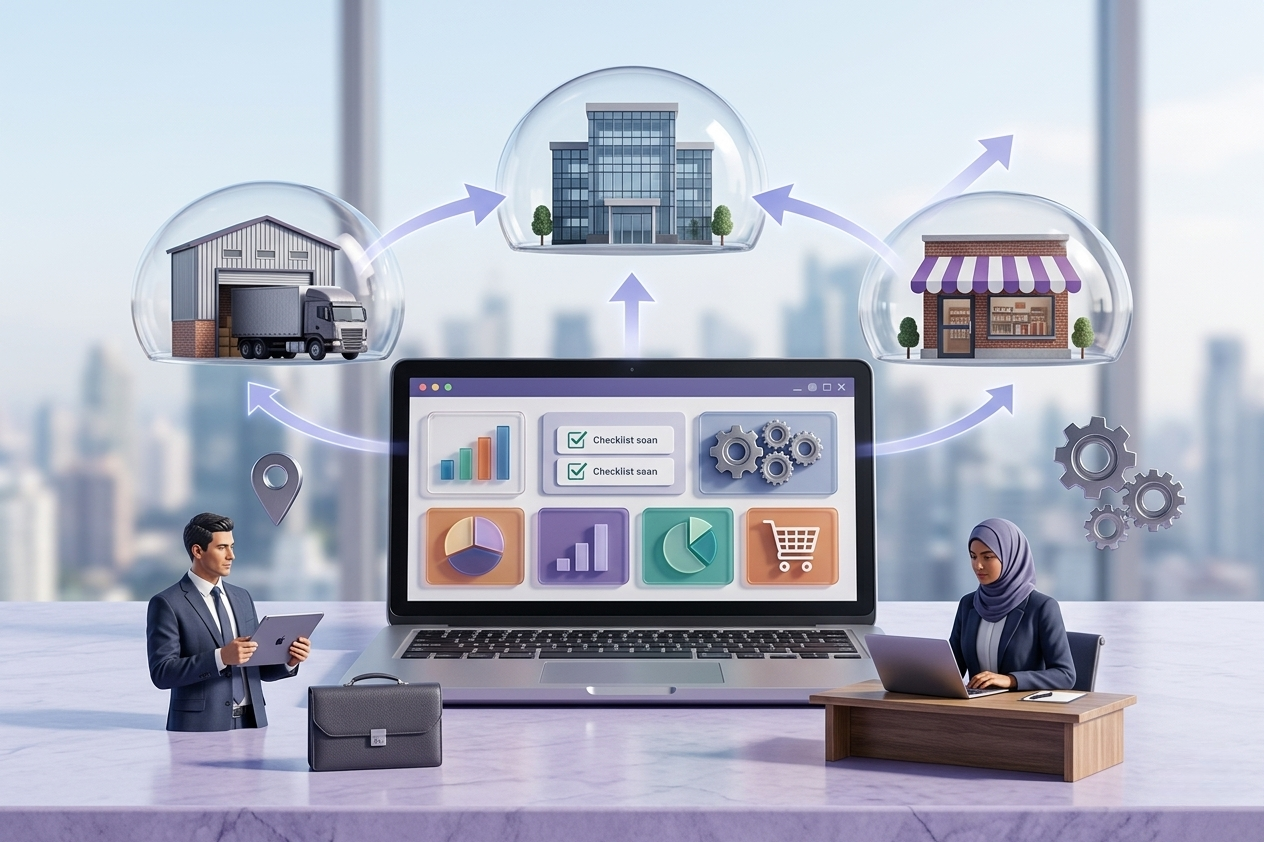




When a business opens a new branch, it isn't just sales opportunities or customer service touchpoints that increase—control questions multiply rapidly: Who holds pricing discount authority? Where is physical inventory accurately visible? Can executive management analyze each branch's real profitability without relying on manual, delayed spreadsheets? At this stage, asking is Odoo suitable for multi-branch operations becomes an essential operational and financial decision rather than a simple software choice. The answer is generally yes, but real implementation success depends on designing the organizational structure, user permissions, and inter-branch workflows before technical setup begins.
Odoo ERP integrates Sales, Purchasing, Inventory, Accounting, and Human Resources into a single unified environment, keeping critical data accessible to each branch within strict operational boundaries. However, configuring multi-branch operations is not a simple feature turned on with a single button. It is a strategic decision that determines how companies, warehouses, points of sale, and analytical accounts are defined—directly impacting daily reporting, financial closing, and overall customer experience.
When Is Odoo Truly Suitable for Multi-Branch Operations?
Odoo is ideal for enterprises that share central management or administrative services across branches while needing to measure independent performance per location. This applies to retail chains, restaurant groups, wholesale distributors, field service providers, contracting businesses with multiple active project sites, and companies managing regional warehouses or remote sales teams.
If branches share a single legal entity and accounting chart but manage location-specific sales, operating expenses, and inventory, Odoo can be configured to track each branch's KPIs while maintaining a consolidated view for executive leadership. Alternatively, if branches are legally distinct entities—with separate tax records, commercial registrations, and bank accounts—Odoo's multi-company framework is the appropriate architecture, enabling structured inter-company transactions when necessary.
Conversely, if the only operational difference between locations is stock storage, with no independent financial governance or pricing policies, setting up multiple warehouses and operational locations under a single company is sufficient. Selecting a structure more complex than needed increases operational overhead, while choosing a model simpler than reality weakens internal controls and post-launch reporting.
Understanding Branches, Warehouses, and Companies in Odoo
One of the most common pitfalls in ERP implementations stems from imprecise business terminology. In general business language, a "branch" might mean a retail showroom, a regional office, a service center, or a distinct legal subsidiary. Within Odoo, this business definition must be translated into a precise data model and operational workflow.
Operational Branch Under a Single Legal Entity
This approach fits organizations operating under one Tax ID, unified accounting policies, and centralized financial management. Specific POS terminals, warehouses or storage zones, price lists, employees, and sales teams can be mapped to each branch. To evaluate local profitability, analytical accounting and multi-dimensional tracking tags are assigned to record revenues and expenses at the branch level.
The primary advantage is streamlined financial closing and a single, unified chart of accounts and master data catalog. However, shared overhead expenses—such as central office rent, corporate marketing, or management salaries—must be allocated according to a clear, agreed-upon methodology to prevent skewed profitability reports across branches.
Multi-Company Setup Under Central Management
When each branch or entity operates under an independent commercial registration, separate tax liabilities, distinct bank accounts, or isolated legal contracts, a multi-company configuration provides superior control. Authorized managers can easily switch views across companies, while branch employees see strictly the data assigned to their specific business unit.
This structure natively supports inter-company trade, such as a central distribution entity selling stock to a branch company or providing centralized management services. It requires disciplined configuration of inter-company accounts, transfer pricing rules, tax rules, and approval chains. It should be selected when required by legal framework and tax compliance, rather than solely to segment financial reports.
How Odoo Unifies Multi-Branch Workflows
The true value of Odoo does not come from placing branch data onto a shared screen, but from harmonizing end-to-end operational cycles without stripping local operational autonomy. In sales, an order can originate at a local branch and be fulfilled from a central warehouse if stock is locally unavailable, providing complete visibility over delivery and invoicing status. In procurement, replenishment planning can be driven by real-time inventory velocity per warehouse rather than manual, delayed estimates.
For retail and restaurant chains, Points of Sale (POS) integrate directly with assigned branch warehouses and user accounts, recording transactions instantly in inventory and accounting ledgers. In field services and contracting, projects, personnel, and expenses are linked directly to specific branch locations, providing leadership with exact visibility into operational execution costs and contract profitability.
Unifying operational data eliminates duplicate versions of truth. Instead of disconnected spreadsheet files for local sales, corporate finance, and warehouse stock, decisions are backed by real-time operational data. However, transparent reporting does not mean unlimited visibility for every employee; sound system architecture carefully balances executive oversight with role-based data privacy.
Permissions and Reporting: The Decisive Success Factor
Multi-branch deployments succeed when user permission roles align strictly with real operational responsibilities. A branch manager may require authority to approve discounts up to a defined limit and review local sales or stock levels, but does not need access to company-wide payroll or bank account configurations. Central accountants need broad financial visibility, whereas warehouse staff require access strictly to receiving, stock transfers, and physical inventory audits.
In Odoo, user access profiles can be tailored by user groups, operational teams, companies, and specific warehouses, complemented by automated approval routes for discounts, purchase orders, and expense claims. Granting broad, unrestricted admin permissions to speed up initial deployment is strongly discouraged, as remediating security gaps later is costly and risky in environments handling cash, inventory, and official tax invoices.
Key reporting requirements must be defined prior to system configuration. Management typically requires comparative reporting across branches for sales velocity, profit margins, slow-moving inventory, collection rates, and operational expenses. Branch managers need actionable daily indicators, including sales per employee, out-of-stock items, pending orders, and cash register reconciliation variances. Establishing these requirements early guides the design of analytical account structures, branch nomenclature, and daily logging standards.
External Integrations and Saudi Regulatory Compliance
Proper multi-branch architecture is even more critical when integrating with external digital platforms. An e-commerce storefront may route online orders for fulfillment from the closest physical warehouse; shipping carrier integrations require exact branch pickup and address metadata; biometric attendance systems must map employees accurately to operational sites; and payment gateways or POS terminals must reconcile revenue directly to the correct branch account.
In the Kingdom of Saudi Arabia, ZATCA e-invoicing and tax compliance requirements must be integrated into the foundational system design. Tax identification details, invoice sequence numbering, QR code generation, and required transaction metadata must be configured across every company and branch structure. Addressing structural entity definitions early during business analysis ensures stable compliance and smooth external integrations upon system launch.
Critical Decisions Required Before System Configuration
Implementation should never start by blindly cloning settings across branches. Begin by mapping actual physical and financial workflows: Does each branch manage isolated inventory? How are stock transfers between branches authorized? Who approves discounts and expense records? Are expenses logged locally or centrally? Do branches operate under a single tax registration or multiple legal entities?
Following operational mapping, a detailed GAP Analysis compares existing business procedures against standard Odoo functionalities. This diagnostic highlights where standard system settings suffice and where custom development, workflow adjustments, or external integrations are required. Not every local branch variation warrants custom code; adopting a standardized operational policy is often superior to digitizing inconsistent local practices.
Master data cleanliness—covering product catalogs, customer files, vendor records, price lists, and opening balances—is a fundamental prerequisite. Migrating unstandardized, duplicate records into a centralized ERP system does not resolve operational errors; it causes them to spread faster. Consequently, data migration requires rigorous cleaning, deduplication, and thorough acceptance testing across realistic sales, purchasing, stock transfer, return, and financial closing scenarios.
Multi-Branch Deployments Demand an Experienced Operational Partner
Implementing Odoo for multi-branch organizations is far more than a software configuration task. It demands structured workflow design, fine-tuned access permissions, master data migration, third-party integrations, User Acceptance Testing (UAT), and targeted role-based training. It also requires sustained post-implementation support, as critical operational edge cases usually surface during initial stock counts, period-end closings, or expansion into new branches.
At Global Solutions, the implementation roadmap begins with comprehensive operational needs and GAP analysis, followed by tailored Odoo configuration, integration governance, data migration, user training, and structured Helpdesk support. The goal is not merely going live, but equipping leadership with a reliable system for control, reporting, and scalable decision-making as the business expands.
The ultimate evaluation of Odoo is not simply how many branches the system can technical support, but how prepared your organization is to align operational rules while maintaining necessary local flexibility. When these foundations are built with clarity, opening your next branch becomes a structured, measurable expansion rather than an added burden of disconnected spreadsheets and fragmented systems.