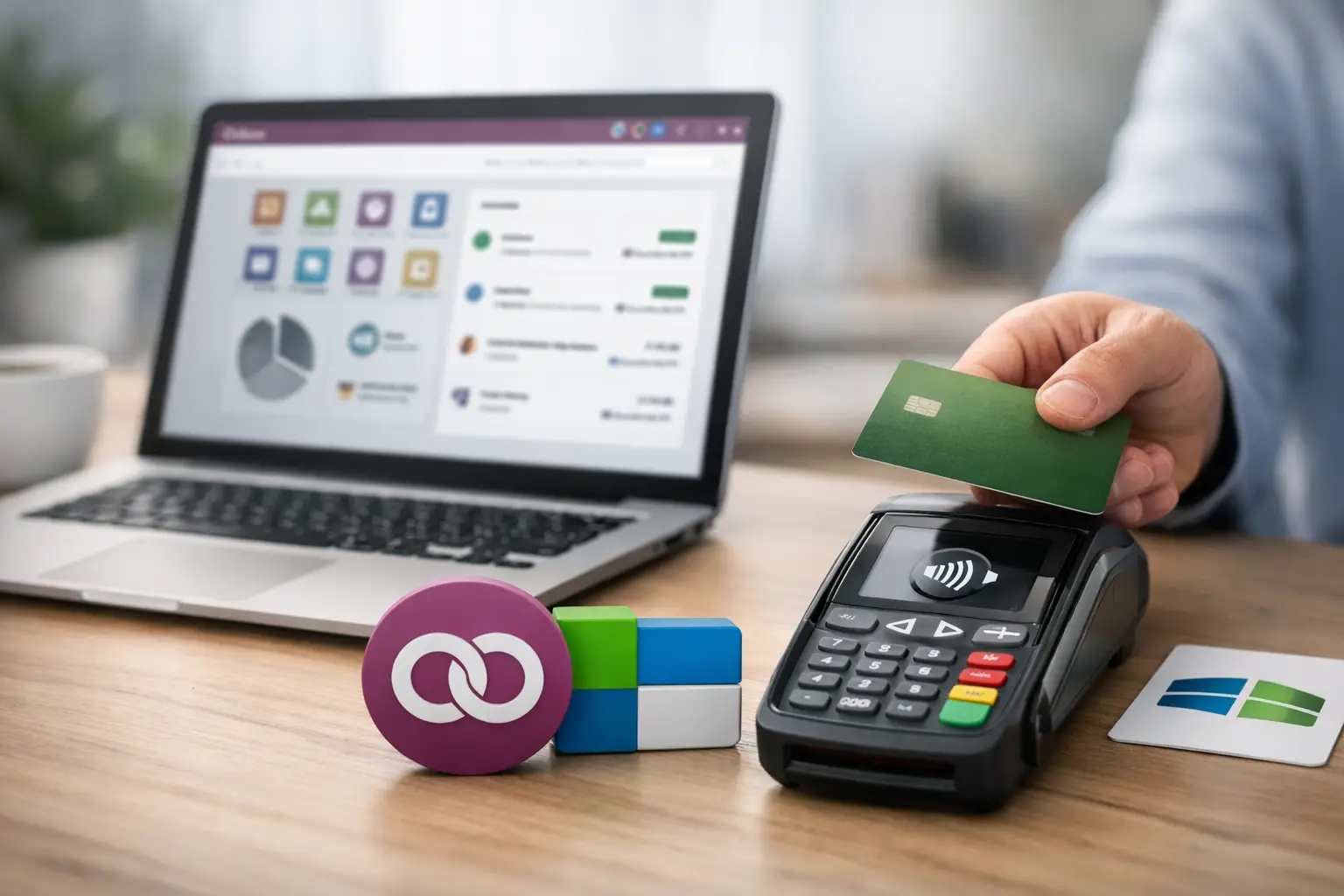
When the reconciliation of payments with invoices is delayed, the bottleneck isn't merely the transaction itself; it disrupts collections, reporting, month-end closing, and the overall customer experience. This highlights the operational value of integrating Odoo with the Mada payment gateway directly within the business workflow, rather than treating it as an isolated technical add-on. For enterprises relying on Odoo to manage sales, accounting, inventory, or Point of Sale (POS), a proper Mada integration eliminates numerous manual steps and grants financial and operations teams precise real-time visibility over cash flow.
Why Do Businesses Need Odoo Integration with the Mada Payment Gateway?
In many companies, sales are recorded inside the system while payments are captured through a separate channel, leading to tedious manual data entry or delayed reconciliation. This disconnect creates clear gaps: paid invoices do not immediately reflect in the system, sales orders hang waiting for confirmation, and collection reports fail to mirror reality in real time.
When an integration is executed properly, payment becomes part of a unified cycle that begins with an order or invoice and culminates in a traceable journal entry. This point is exceptionally critical for businesses with high daily transaction volumes, such as retail networks, restaurants, service sectors, or multi-branch operations. The core benefit extends beyond faster checkout; it establishes rigorous control over the operational status of every transaction from creation to final settlement.
Most importantly, this type of integration reduces reliance on manual guesswork. When payment status, bank references, transaction outcomes, and financial settlements are all linked natively within Odoo, decision-making relies on actual data rather than scattered checks between sales, finance, and IT teams.
What Does the Integration Actually Encompass?
Not all integration projects are identical. In some instances, the scope is limited to accepting payments via Mada for e-commerce checkouts or electronic invoices. In other scenarios, the project is broader, encompassing retail POS hardware, field sales collections, approval workflows, returns, and bank clearing reconciliations.
Practically, integration involves passing transaction details from Odoo to the payment gateway, receiving the transaction outcome, and updating the corresponding record inside the ERP. This record might be a customer invoice, a sales order, a POS ticket, or an accounting payment entry. Next comes the reconciliation phase—the segment that matters most to the finance department—because a successful transaction is useless if it fails to reflect correctly in ledgers and reports.
Here, a distinction must be made between two operational levels. The first is immediate payment validation, which is confirmed instantly inside Odoo. The second is final bank settlement, which may clear on a different schedule depending on the service provider and the bank. Confusing these two levels causes significant friction during deployment, which is why the integration should be engineered from day one to distinguish between transaction acceptance and full financial settlement.
How Does the Execution Lifecycle Look in Odoo?
From an operational standpoint, a successful project initiates with a gap analysis rather than writing code. The team must define exactly where the payment method will appear, what document types trigger the collection, who holds authorization for cancellations or refunds, and how failed or pending transactions are managed.
Following this comes the technical configuration stage within Odoo. Here, the payment environment is provisioned, Mada gateway credentials are mapped, accounting charts are aligned, and user interfaces are tailored to the usage scenario. If the company operates an e-commerce platform, priority goes to seamless order confirmation and checkout within the same thread. For internal sales or invoicing, the priority shifts to updating invoice status, capturing payment receipts, and linking bank or operational references.
Then comes the testing phase, which should never be rushed. Validation must extend beyond checking if a basic transaction succeeds; it must evaluate what happens when a payment is declined, an order is duplicated, the network drops, a user navigates back mid-transaction, or a discrepancy occurs between the invoice total and the paid amount. In live operational environments, these exceptional edge cases define solution quality far more than the ideal success path.
Common Challenges in Integrating Mada with Odoo
The most frequent error is treating the integration as a purely technical project. In reality, its success depends on accounting, operational processes, and customer service just as much as software development. If the internal collection cycle is messy, adding a payment gateway will not eliminate the confusion; it will simply pass it down to the system level.
Reconciliation presents another distinct hurdle. Some companies prefer to close invoices automatically upon transaction success, whereas others require an intermediate clearing account status until final settlement advice arrives. This decision relies on corporate policy, transaction volume, and internal control mandates. There is no one-size-fits-all approach.
Managing refunds and cancellations is equally vital. In businesses dealing with variable orders or customer returns, a transparent framework must exist to reverse the transaction across the invoice, general ledger, and customer ledger. If this part is left to manual processing post-launch, the original inefficiencies will resurface under a different guise.
Furthermore, security and compliance are paramount. A payment gateway integration leaves no room for shortcuts regarding API key management, user permissions, audit logs, or environment separation between testing and production. Enterprises looking for long-term stability require a maintainable and scalable solution, not a rushed fix just to go live.
Where Is the Greatest Business Value Realized?
While the immediate payoff is felt at checkout, the broader impact ripples across multiple departments. The sales team views precise order statuses, finance secures optimized data for matching and reporting, customer support responds rapidly to payment inquiries, and executive management acquires clear visibility into completed vs. failed transaction percentages.
For omni-channel or multi-branch operations, the integration becomes exponentially valuable. Gathering payments from e-commerce, retail POS, or direct sales within a single ERP platform cuts redundancies and improves internal control. This is essential for companies aiming to scale up without generating a parallel surge in manual administrative workloads.
Additionally, the link minimizes human error. Manually inputting transaction data, transferring references between fragmented software, or waiting for unorganized settlements consumes time and opens the door to ledger discrepancies that could have been prevented from the outset.
When Does the Integration Require Customization Over Standard Setup?
If a company utilizes a straightforward invoicing and collection thread, a standard setup with minor configuration might suffice. However, when complex internal approval thresholds, multi-branch routing, variable currencies, distinct refund structures, or deep integrations with third-party applications come into play, customization becomes necessary.
This is also true for organizations where payment validation must trigger subsequent automated actions within Odoo, such as generating delivery orders, creating specific journal entries, updating membership statuses, or routing the transaction to another department for review. Here, we are discussing a step within a much larger business process. Thus, the engineering must align with the company's actual workflow, not a generalized view of electronic payments.
For this reason, the most successful projects combine functional business analysis, rigorous technical execution, and comprehensive post-launch user training. Even the finest integration fails to deliver if users lack the training to handle pending, rejected, refunded, or duplicated transactions properly.
How to Select the Right Implementation Partner?
Choosing a partner should not depend on programming capabilities alone. The project demands an entity that understands Odoo as an operational core, as well as the downstream impact of integration on accounting, sales, reporting, and daily support desk operations. Inquire about their analytical methodology, validation testing plans, exception management protocols, and post-launch support structures.
A quality partner delivers the project as an end-to-end journey: analysis, execution, comprehensive testing, deployment, and ongoing support services. This is critical because integrations are not measured merely by day-one functionality; they must remain resilient through Odoo version upgrades, transaction volume spikes, and evolving business needs. This highlights the value of working with a team possessing proven experience in Odoo integrations and surrounding systems, such as Global Solutions, particularly when the objective is building a stable ERP architecture engineered to support long-term growth.
Before Launching the Project: What Must Be Settled Internally?
Prior to execution, management should clarify several operational parameters: Does the payment lifecycle initiate from the sales order or the invoice? What specific status constitutes a successful collection from the accounting perspective? How will payment variances be handled? And who holds the authority to approve refunds or cancellations? These questions may seem operational, but they dictate the entire architectural design of the integration.
Furthermore, define success metrics from the start. Is the target to reduce reconciliation time, raise electronic collection percentages, minimize manual input errors, or accelerate month-end closing routines? When these targets are distinct, project evaluation becomes objective, and customization decisions remain focused.
Integrating Odoo with the Mada payment gateway is more than a technical upgrade to checkout options; it is an organizational step that restructures the entire collection lifecycle. The closer execution maps to daily operational realities, the more stable and scalable the outcome becomes. The true difference isn't marked merely by the first successful transaction, but when the system runs smoothly at month-end, the ledgers match perfectly, and teams remain confident that financial flows are moving exactly as they should.