


Imagine you are ready to launch Odoo because you are tired of Excel spreadsheets, disconnected systems, and repeated data entry. You start meeting potential partners, and each one assures you they “understand your business” and that the implementation is “easy.” Two months later, you realize the problem was not Odoo at all — it was choosing the wrong partner: incomplete analysis, underestimated integrations, painful data migration, and training that fails to change how users actually work.
This article offers a practical guide on how to choose a certified Odoo partner in a way that reduces risks and increases the chances of project success from the start. Official certification matters, but it is not enough on its own. The real difference appears in execution discipline, understanding operational workflows, integration capabilities, compliance expertise, and long-term support after go-live.
Why Choosing the Partner Matters More Than Choosing the System
Odoo is a flexible platform. Flexibility is powerful when requirements and boundaries are clearly defined, but it becomes a weakness when a project begins without a precise scope and expected outcomes. The implementation partner translates your operational goals into system configurations, user permissions, approval workflows, reports, and integrations.
If your company operates sales, inventory, accounting, HR, and projects simultaneously, what you need is not simply installing software — you need a full end-to-end implementation with an understanding of real constraints such as invoicing rules, multiple branches, credit policies, customer pricing, or batch and serial tracking.
How to Choose a Certified Odoo Partner: What Certification Really Means
Certification provides two indicators: the partner is part of the official Odoo partner network, and they meet the platform’s minimum experience standards. However, certification alone does not tell you three critical things: the quality of project management, their experience with integrations, and their ability to lead change within your team.
Therefore, treat certification as an entry requirement — and then begin the real evaluation.
Start with GAP Analysis, Not a Price Quote
The earliest sign of a strong implementation partner is how they approach discovery. A good partner does not begin with predefined modules and quick price estimates. Instead, they start with GAP Analysis — a process comparison between your current operations and the desired future system.
Ask how they document processes. Will they deliver clear outputs such as workflow diagrams, permission matrices, reporting lists, and defined integration points? If the answer is vague or based on “we’ll figure it out as we go,” that is a risk. In Odoo projects, unclear requirements at the beginning often become expensive changes later.
A proper GAP analysis may reveal that some requirements you assumed required customization can actually be handled through configuration, while other seemingly simple requests may require integrations or structured data design. This step saves budget and stabilizes the project scope.
Evaluate Industry and Workflow Experience
Do not look for a partner claiming expertise in everything. Instead, look for experience in workflows similar to yours. There is a major difference between a professional services firm that relies on project billing and milestones, and a wholesale business dealing with credit limits, returns, and multiple pricing structures.
During presentations, ask them to walk through a real operational scenario from start to finish. For example: quotation → sales order → inventory reservation → shipment → invoice → payment collection → accounting entries and reports. If the explanation remains theoretical and skips operational details, implementation will likely struggle with those details later.
Integrations Are Not an Add-On — They Are Part of the Design
In the Saudi market, ERP rarely works in isolation. Companies often depend on e-commerce platforms, shipping companies, POS systems, attendance systems, payment gateways, or regulatory integrations. This is where the value of a partner with a real integration portfolio becomes clear.
Focus on two questions: which integrations have you actually implemented before, and how do you monitor and manage integration failures? Integration is not just connecting APIs — it is designing data flows. What happens when shipment confirmation fails? How are returns handled? Which system becomes the single reference for order status?
If your business depends heavily on external operational systems such as shipping or payment gateways, a partner with ready integration frameworks significantly reduces time to value.
Data Migration: Test the Methodology, Not the Promise
One of the most common causes of delays and frustration is data migration. Many teams promise to migrate “everything,” but later discover the data is inconsistent, fields do not match, or historical accounting records require careful processing.
Ask for a clear methodology. How will data be cleaned? Do they provide import templates? How do they ensure customers, vendors, products, and accounts remain properly linked? How will they verify the data after migration? Most importantly: what will actually be migrated, and what will remain archived?
In many cases, migrating every historical record is not the best decision. Migrating opening balances and key documents while preserving historical archives in their original system may be the more practical approach.
Customization: When It Helps and When It Hurts
Odoo is highly customizable, but customization can solve today’s problem while increasing future maintenance and upgrade costs.
Ask how the partner approaches customization decisions. Do they prioritize configuration first, approved add-ons second, and development only when necessary? Do they document their code clearly? Do they plan upgrade testing when Odoo versions change?
If their strategy is simply “we will develop everything,” that is a warning sign — especially if you plan to upgrade your system later.
Compliance in Saudi Arabia Should Not Be an Afterthought
E-invoicing and ZATCA compliance are not cosmetic features. They directly affect invoice structures, tax coding, and operational workflows. If your business has multiple branches, legal entities, or complex discount and tax scenarios, your partner must be experienced with these requirements.
Ask directly how they ensure compliance in cases such as returns, credit notes, and simplified invoices. Also ask about their experience configuring invoice templates and mandatory ZATCA fields inside Odoo.
Project Management and Change Management
ERP projects usually fail because of project management and change management — not technology.
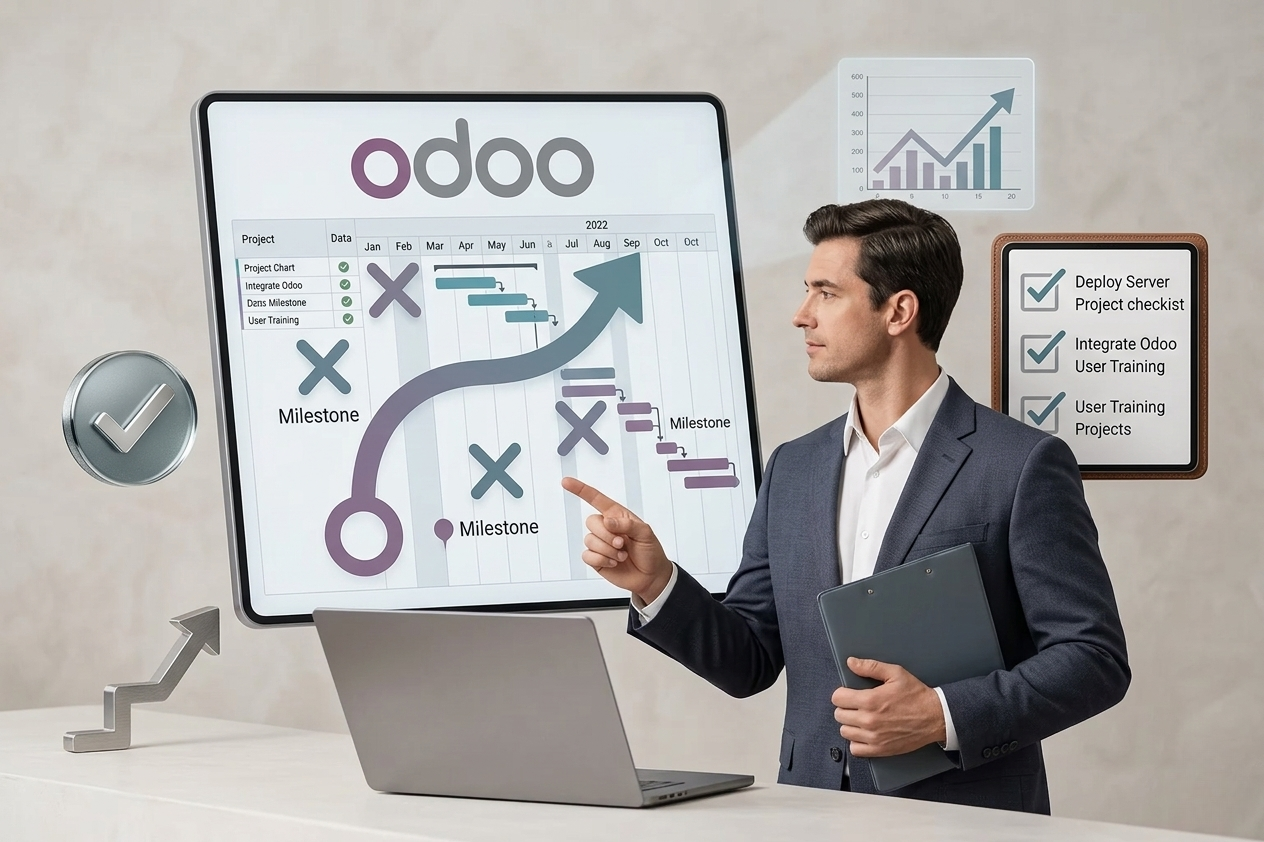
Understand how the project will be managed: clear phases, defined deliverables, requirement approvals, and structured UAT testing. Ask how your internal team will participate. Will each department appoint a process owner? Is training role-based? Is there a staging environment before go-live?
Most importantly, confirm that the partner does not disappear after go-live. Long-term success requires structured helpdesk support, service agreements, and clear response times.
Evaluate Post-Go-Live Support Before Signing
Do not rely on promises of “support.” Ask to see how their support process actually works. How are tickets submitted? How are they categorized (functional vs technical)? How are priorities handled? Are there monthly reports?
This difference separates partners who deliver ongoing Training & Support services from those who treat support as an inconvenience after the project ends.
Interview Questions That Reveal the Difference Quickly
If you only have one meeting to evaluate a partner, ask questions that force detailed answers. Ask about an integration they implemented and what failure scenarios occurred. Ask about a project that required large data migration and how they handled data quality. Ask about a case where they refused customization — and why.
Strong partners answer with real examples and clear procedures.
Turning All This Into a Clear Purchasing Decision
Your decision should not be between “cheapest” and “most expensive.” It should be between different levels of risk. A cheaper partner may rely on heavy customization and postpone decisions, creating delays later. Another partner may charge more because they invest in GAP analysis, documentation, testing, and training — reducing operational surprises.
A practical rule: choose the partner who offers an end-to-end path — from discovery and GAP analysis to implementation, integrations, data migration, training, and long-term support.
For example, when comparing partners in Saudi Arabia, companies may review the services offered by Global Solutions, which focuses on full lifecycle implementation with strong integration capabilities and ongoing helpdesk support.
Ultimately, before signing any contract, ask the partner to map your operational day after go-live — step by step — including integrations, approvals, and reporting flows. When the operational day becomes clear on paper, implementation surprises become much less likely, and Odoo becomes a project of operational improvement rather than emergency repair.